Just like old times.

%201.avif)

The House passed a set of funding bills—including for both defense and homeland security—that now head to the Senate in hopes of speedy passage to avoid another government shutdown, with only days before the end-of-January deadline.
Dig Deeper
Before the passage of the bills through the House, Politico reported that President Trump had warned of the possibility of another shutdown. Breaking Defense reported the defense funding bill included $8 billion more than the Pentagon requested. And Federal News Network reported that Congress, while supportive of the department's efforts to overhaul the acquisitions process, "pushed back on the Pentagon’s efforts to seek additional authorities" to do so.
The Pentagon rather unexpectedly released its long awaited NDS Friday night, which Sec. Hegseth had outlined last month at the Reagan National Defense Forum.
After days of bluster and maximalist positioning, the president left Davos this week with a 'framework,' signaling discussions will continue regarding Greenland.
The president confirmed this week that military action is indeed still on the table regarding the protests in Iran as U.S. forces converge on the CENTCOM area of responsibility.
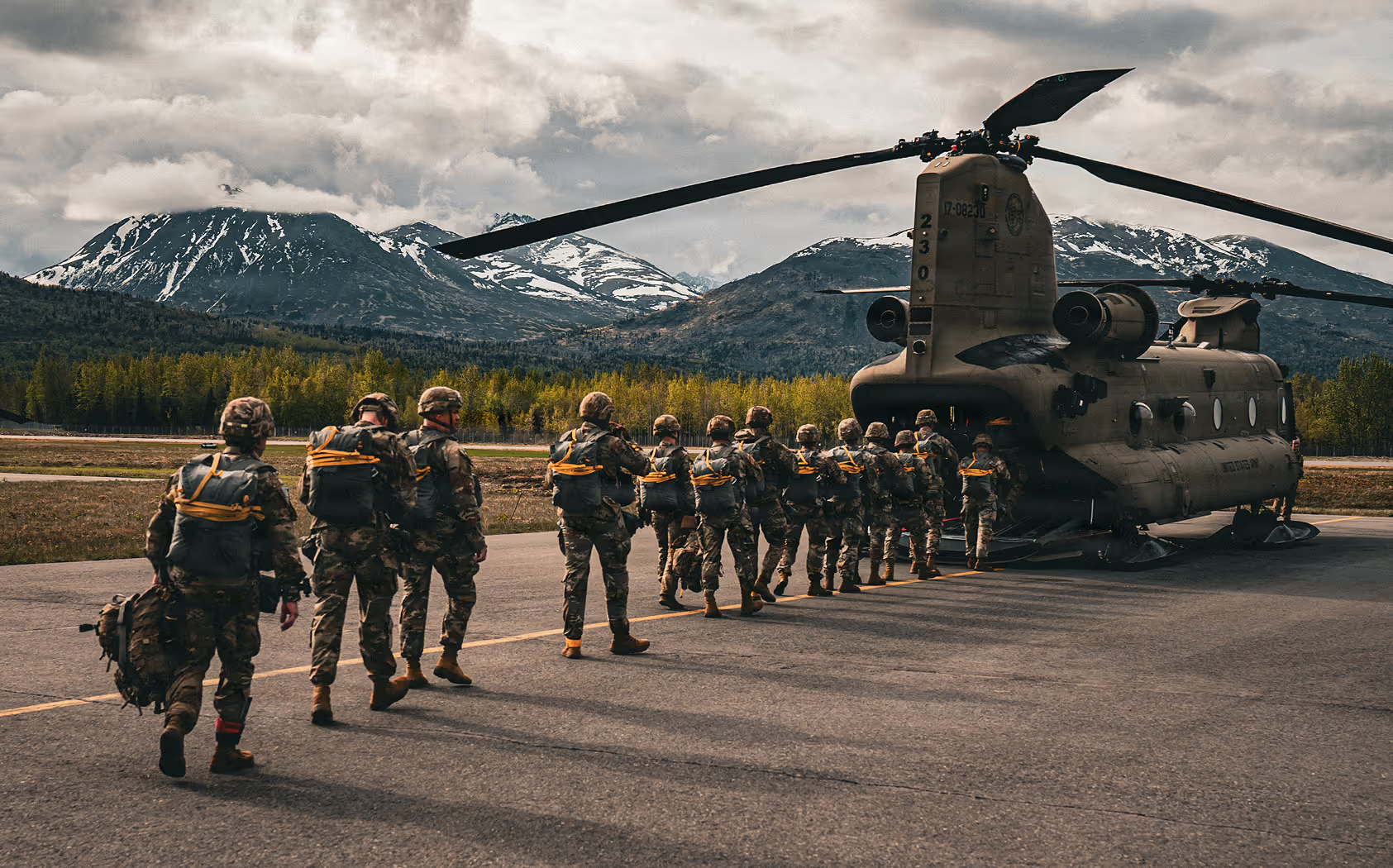
The U.S. Army has ordered several dozen additional active-duty soldiers to prepare for a possible deployment to Minneapolis if needed amid protests over the Trump administration’s immigration enforcement crackdown.
"We are taking a sledgehammer to the oldest DEI program in the federal government," Sec. Hegseth said in a post on X. He has ordered a line-by-line review of every sole-source 8(a) contract over $20 million.
While the U.S. struggles to add rare-earth factories and drone-test ranges, Beijing is creating them in clusters. The city of Baotou is now working to establish entire next-generation production chains.
The Trump administration has yet to provide Congress with budgetary and other information about the Golden Dome homeland missile defense program as directed, impairing congressional oversight of the multi-billion dollar effort, according to House and Senate sources.
The Pentagon’s Agency Financial Report for FY 2025 excludes any mention or performance-related information about Advana, fueling uncertainty that began when the department placed an indefinite pause on the recompete.
AI promised faster decisions, lower costs, and better readiness across the force. Instead, many early efforts stalled or failed to scale because of fragmented, outdated data systems.
As the world focuses on the politics of the situation that is shaking up alliances, take a closer look at Greenland’s position at the crossroads of nuclear defense.
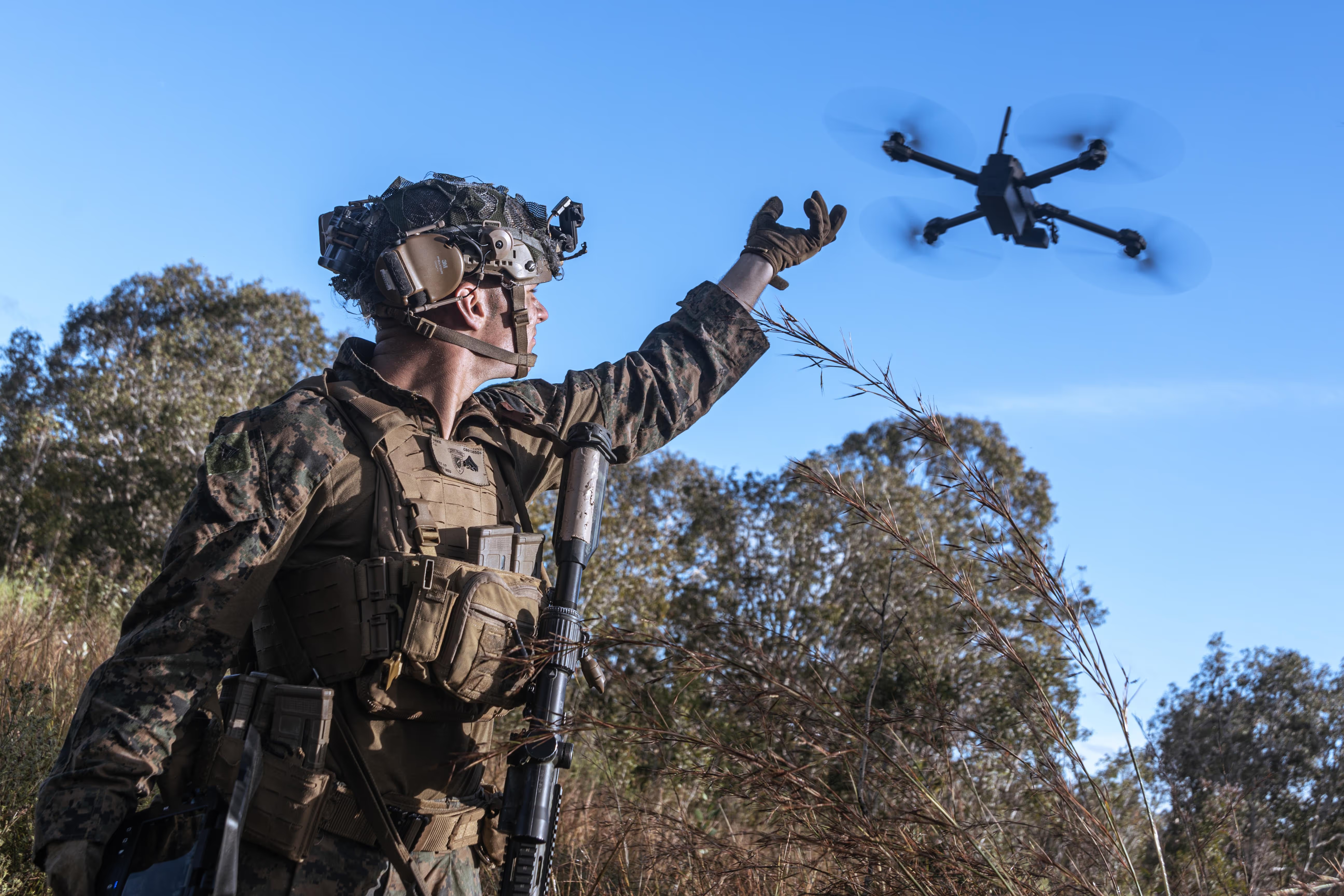
The Pentagon is challenging drone makers to prove their mettle in the first phase of its Drone Dominance Program, which was announced late last year and starts in February. To pass the test, companies will have to navigate scaling operations with little time for planning or on-the-job training.
Dig Deeper
In her article, Kay points out that Ukraine, which has become a proving ground for unmanned systems, is an intuitive benchmark for how much room U.S. manufacturers still have to scale production. Breaking Defense spoke with Stayne Hoff, director of business development at Red Cat, about the future of unmanned systems in an entirely different theater of potential conflict.
Why you should read The MC Post every Saturday morning.
We’re bringing back the familiar comfort of unfolding the weekend newspaper and catching up on the headlines, without the tacky popups, scammy ads, or bait-and-switch paywalls that you’ve come to know and hate. In a world racing toward AI-generated content, the MC Post is curated by people for people. Brought to you by Mission Cultivate—the free networking platform for defense and national security pros.
Feature Commentaries
To catch up, the U.S. government needs to consolidate fragmented entry points and convert capability gaps into commercial contracts at speed through a unified national security space front door, argues Isobel Porteous, head of business development at EarthTraq Corporation.
Despite a nearly 32 percent drop in bid protests over the last decade, the Pentagon is taking a look at the process, pointing to a more structured—and potentially more adversarial—protest landscape.
Ryan Gury, CEO of Performance Drone Works, argues commercial technology scales for warfighter needs in ways internal defense tech cannot because it is accessible, affordable and adaptable.


It's literally rocket science! Ben Nicholson, chief business officer of Ursa Major, talks additive and agile manufacturing for defense aerospace and propulsion capabilities.
Dig into the Air Force's alphabet soup and see who the Air Force has tapped to be program acquisition executives as the Pentagon rebrands its program executive offices.
Editor's Notes
If you heard a collective sigh of relief this week, it was probably because Congress beat their own low expectations and made forward progress on a series of funding bills, including defense, which actually exceeded the executive’s request. The shutdown risk isn’t zero, but given the temperature of things happening right now at home and around the world, the lack of pushback or posturing to use a budget fight as a political tool is striking. All signs point to a funded government and, hopefully, a swift resolution on the SBIR/STTR impasse that is seriously putting small businesses at risk.
I’d be remiss if I missed the chance to offer a huge thank you to Dolores Kuchina-Musina, who took a leap of faith with us last week as our first guest editor! We’re so excited to get new voices and ideas into this publication, so expect more soon. In that spirit, don’t miss The MC Post’s original content this week from Jen Kay, who lays out the real challenge facing drone builders. Hint: it’s not just designing drones! Kay points out that the Pentagon’s Drone Dominance Program is moving forward, and it’s a good reminder that the wheels of industry churn even amid the chaos of budget uncertainty and rapidly changing international situations. And it’s for that reason that the article this week that most caught my attention wasn’t a headline about Greenland or Iran—it was Military.com's quiet meditation on the Stoic commander.
If you’ve been around for a minute, word of former defense secretary James Mattis’ affinity for the philosophical tradition of Marcus Aurelius is nothing new. Commanders often have to embody discipline and make logical decisions during chaos (“Mad Dog’s” real call sign. IYKYK). But what does stoicism offer for the rest of us? Why does a defense contractor care? Though there is much to learn from a former Roman emperor, I’d humbly recommend Epictetus, whose story is compelling because it captures the entire other end of the spectrum. Born a slave, Epictetus’ reflections are all the more powerful because they come from the perspective of a man who found freedom first in his mind. Someone who could only control his reaction to the world around him, not the events themselves.
“Seek not that events should happen as you wish, but wish them to happen as they do happen,” he said in the Enchiridion. Said for the modern reader: Spend time reacting to reality, not wishing it were different. Sound familiar?
Policy is changing by the day. Find what you can control.
Funding is uncertain. Seek what adds value.
Politics distracts from the mission. Replace frustration with focus.
One of Epictetus’ students later shared a story the philosopher would tell his followers. One night, upon hearing a commotion, Epictetus discovered a thief had entered his home and stolen an iron lamp—one of his only earthly possessions. Rather than be frustrated at the misfortune or curse the thief, he simply decided to buy a cheaper, stone one to replace it, reasoning the thief would have less cause to return. He didn’t respond by demanding retribution or wallowing in the loss. He redesigned his environment so future impacts would cost him less.
When the next big headline makes you feel unmoored or uncertain, recenter the conversation and position yourself so disruption has less leverage over you. I truly believe those who thrive will be those who remain calm and adapt with discipline.
Thanks for attending my philosophy talk. And thanks to Military.com for the inspiration!
Happy reading this week,
| Beau Downey, Editor
The views represented in this commentary are my own and do not constitute endorsement by the Department of Defense or the U.S. Government.

More In Depth
After Sec. Hegseth announced changes to the military's innovation ecosystem last week that shift AI away from being viewed simply as a standalone product, see what it will take to turn strategy into action.
The bottom line takeaway is nothing earthshaking: CRs make doing the mission harder. If you need data to back that up, you can find it here.
As legacy platforms are retired and inventories shrink, preserving a circular sustainment economy becomes essential to controlling costs and sustaining readiness.
Happening on MC
If you're not on Mission Cultivate, here's just some of what you're missing.
Opportunities
Event Conversations
Continue Reading
Staffing problems caused by last year's DOGE-related cuts resulted in DISA warning of “extreme risk for loss of service” across the military.
Combat decisions are made with limited time, incomplete information, and real consequences. Yet many of the most effective commanders in history shared a common trait that rarely makes headlines: stoicism.
As the service phases out old software—and the money budgeted to keep it running—the SEC’s executive director has a bold plan to keep his almost 900 civil service employees relevant, competitive and funded.
At a time when there is intense focus on NATO, this release is a reminder that the relationship really exists at the tactical level when partner nation forces work together.
Lt. Gen. James Adams III, who led the Marine Corps through two clean audits, was nominated as director of the DIA last week, which has been without a Senate-confirmed director since August.
The cooperative endeavors illustrate how relationships in the spheres of defense trade and other fields are deeply rooted in the fabric of American alliances grown over decades, offering U.S. companies predictable markets and access for troops.

Defense asked. We answered.
After years of hearing "There must be a better way," we built Mission Cultivate–the free, discreet networking platform for Defense and NatSec.
See Mission CultivateHeads up: MC is only for verified users in Defense/War & NatSec. Users include gov, industry, academia, vc, and more. Only available to US, NATO, or select major US allies.