Just like old times.

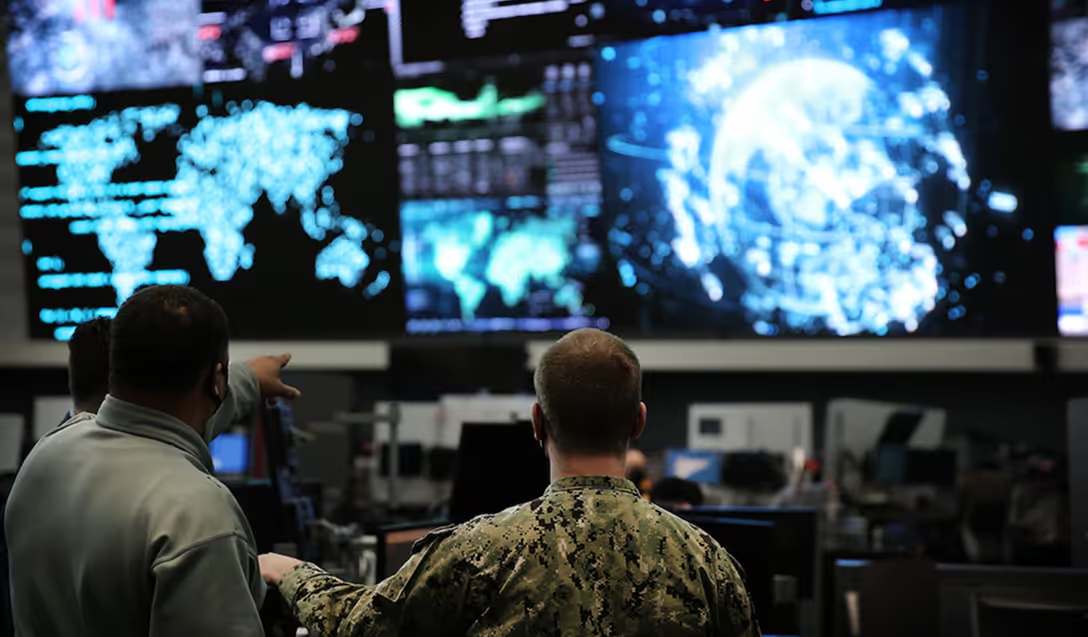

The initiative, which will speed up the adoption of cutting-edge artificial intelligence tools with powerful hacking capabilities, will span U.S. Cyber Command and the NSA and will study how the Pentagon can safely deploy leading AI models in all aspects of its missions.
Dig Deeper
AI models with advanced hacking capabilities like Anthropic's Mythos should concern federal agencies that handle sensitive information, a top CIA tech official said. Read more from Defense One. Marines will now be required to complete a basic level AI course according to Defense Scoop. And President Trump had been expected to sign a new executive order on AI this week, but delayed it after internal disagreements, per Axios.
Top Headlines
Sec. Hegseth is directing the Pentagon to evaluate legal programs across the services, compare them with one another and benchmark them against the Justice Department and criminal justice systems.
Tulsi Gabbard said on Friday she is resigning from her job as director of national intelligence, saying her husband had been diagnosed with a rare form of bone cancer and that she was stepping away from her role to help him.
The head of U.S. forces in the Middle East told senators that the bombing campaign against Iran achieved all of its objectives to "significantly degrade" the country's military capabilities, even as Tehran continues to claim control of the Strait of Hormuz.
Speaking during a tense Senate Appropriations Defense Subcommittee meeting, acting NavySec. Hung Cao informed lawmakers that the administration had halted the sale to ensure that the U.S. retained enough firepower for Operation Epic Fury.
AFRICOM and the Nigerian military said on Monday they had carried out additional airstrikes against Islamic State targets in northeastern Nigeria on Sunday, as joint operations against militant groups intensify.

In 2007, Jo Hamilton pleaded guilty to 14 counts of false accounting and was required to pay £36,000 to recoup money she had apparently stolen in her time as sub-postmistress of the South Warnborough Post Office. Except here's the problem: She didn't steal anything. Six years earlier, in a sleepy town in the south of England, Hamilton had purchased and taken over management of a small community co-op where the town's post office was co-located. By 2003, the sub-postmaster had stepped down — so she filled that role too. She had almost no training, but the pace of business was slow enough that it didn't seem to matter. That same year, a new chip-and-pin machine was installed and the post'office's accounting systems went digital.
IonQ Chief Information Officer Katie Arrington, who served last year as the Pentagon's chief information officer, said the influx of advanced AI tools — and the speed at which they're emerging — will test government to the extreme.
A bipartisan group of lawmakers is renewing their efforts to give service members the ability to fix their own equipment after popular "right to repair" provisions were stripped from the 2026 defense policy bill following strong industry pushback.
The U.S. military's rapid scaling has placed increased pressure on domestic suppliers as they work to maintain operational readiness with the resources, materials and finances required to meet the demand, according to a report from analytics firm RapidRatings.
"The way I've approached this — knowing how smaller companies work — is fast yeses and fast nos. The worst thing for a small company is to be dragged through a multi year process," Pentagon CTO Emil Michael said.
The Pentagon published its second release of declassified and historical Unidentified Anomalous Phenomena files as part of the Presidential Unsealing and Reporting System for UAP Encounters that first published May 8.

Sen. Joni Ernst, R-Iowa said Tuesday during a hearing of the Senate Subcommittee on Emerging Threats and Capabilities that the Pentagon lags in scaling its policy architecture for autonomy. The hearing centered on science priorities in the Pentagon's budget request for fiscal year 2027, especially for the Defense Autonomous Working Group, for which the Pentagon is requesting a massive $55 billion increase.
Dig Deeper
David Breede, deputy director of acquisition for SOCOM, said during remarks at SOF Week in Tampa, Florida, Monday that collaborative autonomy development is not moving fast enough. "The ability to quickly integrate autonomous behaviors on multiple different platforms in multiple different domains, without it having to be specifically built for that platform, is something that I'd like to see move faster than we are right now," he said. Read more from Defense Scoop.
Why you should read The MC Post every Saturday morning.
We're bringing back the familiar comfort of unfolding the weekend newspaper and catching up on the headlines, without the tacky popups, scammy ads, or bait-and-switch paywalls that you've come to know and hate. In a world racing toward AI-generated content, The MC Post is curated by people for people. Brought to you by Mission Cultivate—the free networking platform for defense and national security pros. Each week here you'll find the latest in defense and industry to keep you informed ... and more importantly, save you some time. (Subscribe)
Feature Opinions
Col. Matthew Paul, acting deputy for the Army's Capability Program Executive for Enterprise Software Services, says the single biggest obstacle to faster software development is time spent doing everything except building and delivering software. Shout that one from the rooftops.
Robbin Laird argues The U.S. and Australia are central nodes in a system that seeks advantage not by preventing disruption but by surviving it better than the adversary and continuing to generate combat power.
After trusting the military to fix its own problems with unsatisfactory results, it is time for President Trump and the Congress to seize the reins and establish the United States Cyber Force to address the military's cyber failings.
Worth a listen


The window for government contractors, especially those in defense and space technology, to go public is open again as several listings over the past 12 months show and SpaceX's own offering this year will illustrate. Dave Khalsa, head of mid-cap defense and government technology investment banking at J.P. Morgan, works on transactions of many different types and observes all of them to help companies in the market figure it all out.
Editor's Notes
Each week here I include a single article (or report or similar brief) that goes beyond the headlines in the section appropriately called "In the Weeds." It's right below this one, so you really can't miss it! Especially in an era when we are incentivized to skim and move onto the next story quickly, I think it's important to carve out space for the things that are worth saying in full. This week, you'll find a series of recommendations about American industrial capacity that takes a wider view than the current moment and encourages the continuity of growth across administrations that is contributing to a more durable, more innovative arsenal system. I encourage you to read it in full, but I will point out what I thought was the most interesting point, which is that industrial capacity itself is a deterrent to our adversaries. In a world where China has a stranglehold on rare earth and other critical minerals, even the perception being signaled that we are investing in an independent future affects the balance of power. Also, this week, Mission Cultivate's newest executive, Mollie Jahner, tells us why we have to build systems for government contracting that keep humans not just in the loop, but at the center of why it's all happening. You won't want to miss that one!

In the Weeds
Today's defense industrial base is expanding to include recently established technology companies, as well as legacy defense contractors. That mixed makeup creates a new challenge: Policymakers now need to rebuild stocks of key munitions and ships sourced from legacy contractors, while incorporating artificial intelligence, autonomous capabilities, quantum computing, and other technologies supplied by the newer companies.
Happening on MC
If you're not on Mission Cultivate, here's just some of what you're missing.
Opportunities
Event Conversations
Continue Reading
In a reversal of a move that rattled the Pentagon, President Trump said in a Truth Social post Thursday that the decision was sparked by the "successful election" of Poland's President Karol Nawrocki, whom he "was proud to endorse."
The Department of the Air Force is opening the door for industry to directly influence how future federal procurements are planned, competed, evaluated, and managed. Unlike a traditional RFI tied to a single program, this notice targets the broader acquisition process itself.
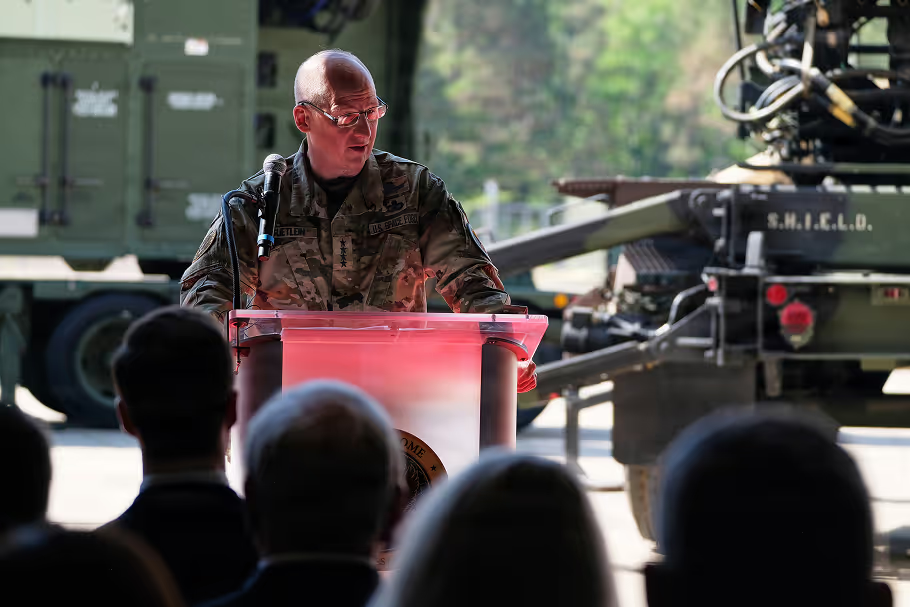
Pentagon officials overseeing Golden Dome are trying to convince commercial space founders, venture investors and software companies that missile defense can be built more like a modern technology platform than a traditional weapons system. That effort is reshaping the ecosystem forming around Golden Dome.
Northrop Grumman was the only traditional defense company picked. The others are Austin, Texas-based Bravo Ordnance, Israel's Kela Technologies, North Carolina's Kraken Kinetics, and Colorado's Mountain Horse Solutions.
Hurst has been the acting Pentagon comptroller since August, supervising the Pentagon’s mammoth $1.5 trillion defense budget request, which includes $350 billion in a reconciliation package.

FREE, GovCloud-Secured Networking Platform for Defense and Industry
Mission Cultivate is the free, discreet networking platform for Defense and Industry. Find the others in national security and collaborate on the solutions warfighters need in one space.
See Mission CultivateHeads up: MC is only for verified users in Defense/War & NatSec. Users include gov, industry, academia, vc, and more. Only available to US, NATO, or select major US allies.