Just like old times.



Ten months in, only $26 billion of the roughly $152 billion earmarked for defense has been placed on contract, Sec. Hegseth said this week during testimony. Congress questioned reliance on the reconciliation process as the Pentagon looks to spend significantly more next year.
Dig Deeper
Testifying before the House Armed Services Committee Wednesday, Hegseth also confirmed an autonomous warfare sub-unified command coming soon, according to Defense Scoop. Watch full testimony here. And the House is taking up a Senate-passed budget resolution that sets nearly $1 trillion in defense spending — roughly $500 billion below the levels President Trump has publicly pushed. Read more from Military.com.
Top Headlines
The surprise move made public Friday is a sign of President Trump's discontent with European allies who have been reticent to support U.S. efforts against Iran. The Pentagon said the withdrawal would happen over the next year. Germany is home to U.S. European Command and a major troop presence at Ramstein Air Base.
On the 76th day since Department of Homeland Security funding lapsed, Congress passed a bill Thursday restoring the flow of federal dollars to most of its agencies — without solving any of the policy disagreements that led to the record-breaking shutdown.
Major AI developers now have deals to install tools in classified military networks. Amazon Web Services, Google, Microsoft, NVIDIA, OpenAI, Reflection, and SpaceX are cleared for Impact Level 6 and 7 network environments.
"Republican majorities on both armed services committees authorized $400 million for the Ukraine Security Assistance Initiative for each of the next two years. Appropriators fully funded that authorization for fiscal 2026 with overwhelming support," McConnell wrote in an op-ed published in The Washington Post.
The Space Force plans to expand the scope of its data transport constellation in the next few years, kick-starting a competition to bring on new commercial capabilities and procuring nine launches in fiscal 2027 to support the hybrid satellite communications network.

On the first of June last year, 117 small drones folded out of the roofs of cargo trucks parked along quiet Russian roads and flew, at close range, into the flightlines of five strategic air bases. Ukrainian operators sitting thousands of kilometers away guided them onto the fuel tanks of Tu-95 and Tu-22M bombers. By the end of the day, Ukraine had destroyed or damaged roughly a third of Russia's long-range cruise missile fleet. These are aircraft that cannot be replaced, because the Soviet industrial base that built them does not exist anymore. Per-drone cost: about $2,000. Operation Spider Web is now being studied in every serious defense ministry in the world. It should be, though not for the reason most commentary has fixated on. The attack was a genuine achievement. Commercial FPV airframes smuggled across the largest country on Earth in hidden cargo compartments and piloted by operators aiming at specific weak points on strategic bombers — that's hard, and the Ukrainian drone program deserves the credit it's getting.
The U.S. government is modernizing its Small Business Innovation Research and Small Business Technology Transfer programs to get after contemporary warfare and national security gaps, senior officials involved in the work said on Wednesday.
After months of confusion about how widely to use the Pentagon's ceremonial designation as the War Department, this seeks to spend $50 million on official initiating the change, with challenges from Democrats in Congress sure to follow.
The current national U.S. missile defense network is limited and incapable of effectively countering attacks from Chinese or Russian hypersonic missiles and advanced cruise missiles, officials said during a Senate hearing this week.
The renewal of the Foreign Intelligence Surveillance Act cleared the House Wednesday. It now goes to the Senate for a likely cold reception because the bill is tied to unrelated digital currency legislation.
The Air Force anticipates buying thousands of new, low-cost cruise missiles annually, and is planning to spend over $12 billion to stockpile the nascent munitions, according to new budget documents.

The 1973 War Powers Resolution says the president has to remove military forces from conflict within 60 days if Congress doesn't authorize a war before that deadline, but Speaker Johnson argues a ceasefire essentially stops the clock on any statutory requirement. Meanwhile, it was confirmed this week that the war effort has cost $25 billion so far.
Dig Deeper
As the U.S. navigates a tenuous ceasefire agreement, AP reported that the military boarded and then later released the cargo ship "Blue Star III," which was suspected of heading to Iran during the ongoing blockade. And CNN has reported that at least 16 American military locations have been damaged in Iranian strikes, making up the majority of U.S. positions in the Middle East.
Why you should read The MC Post every Saturday morning.
We're bringing back the familiar comfort of unfolding the weekend newspaper and catching up on the headlines, without the tacky popups, scammy ads, or bait-and-switch paywalls that you've come to know and hate. In a world racing toward AI-generated content, The MC Post is curated by people for people. Brought to you by Mission Cultivate—the free networking platform for defense and national security pros. Each week here you'll find the latest in defense and industry to keep you informed ... and more importantly, save you some time. (Subscribe)
Feature Opinions
Natsec-focused private companies last year raised $46.3 billion according to PitchBook data. But while this represents a nearly 900 percent jump in the market over the last decade, more money doesn't necessarily mean healthier companies. Kaela Roeder explores ways startups can 'future proof' in the current market.
The United States and Canada are both racing to rebuild their defense industrial bases, recognizing that future conflicts will be determined not only by military capability, but by the ability to produce at scale. But they cannot succeed alone — and importantly, they do not need to start from scratch. Read more from Christopher Zember and Jerry McGinn.
As Britain's monarch was touring the U.S. this week, Rafael Behr's piece points to a wearying mood in the European tech market. He warns that countries like his are at risk of dependency on a handful of companies with what he calls "oligopolistic control over vital digital infrastructure."
Worth a listen


Hosts Chitra Sivanandam and Yevgeniy Sirotin sit down with Sean Batir to examine why data, not just models, is the decisive factor in scaling AI for national security. The conversation breaks down how America's AI Action Plan reframes data as a strategic asset and what it takes to build secure, interoperable, and mission-ready data environments across government and industry.
Editor's Notes
For my fellow sci-fi nerds out there, especially those interest in tech, I have a book series recommendation: Star Carrier by Ian Douglas, which I think is his pen name. This recommendation comes with a small caveat. The plot and character development are a C- at best, but the descriptions of tech 400 years in the future are so compelling, it's truly worth overlooking. In this hyper-technical future, humanity has overcome faster-than-light travel through a theoretical engine called an Alcubierre drive. By the way, that's actually a hypothesized concept you can explore. Essentially it uses gravity to create a wave that allows objects to ride through spacetime and skirt the physical limitations of speed. Of course, because humanity can escape the safe confines of our solar system, we encounter hostile aliens species, and conflict ensues. Douglas goes into exquisite detail of what combat looks like in space and at incredibly high speeds. How do you shoot at something moving at 30 percent the speed of light? He even considers the impact on maneuver: when ships enter faster-than-light travel, they cannot communicate with one another, and they are traveling over such vast distances that their calculations of where to stop are imprecise at best. They come out of warp drive millions of miles apart, meaning the first order of battle is regrouping. Those plans have to be made before the mission ever launches, because Douglas doesn't create some fanciful way around the cosmic speed limit. There is no way to communicate faster than light other than sending a ship back with a message. How do you fight a war when you can't communicate with the political leaders who initiated it in a timeframe relevant to the fight? In a world where major wartime decisions are made by politicians sitting in Washington, it's a hard future for us to imagine. But it's actually the past we need to look to — an allusion Douglas makes well in the series by comparing the armada from Earth heading into the galactic abyss to naval explorers of the 15th and 16th centuries. They left their ports with objectives and intent and little else. When they encountered change or the plan fell apart, they couldn't run back to Europe to ask "what now?". In the books, Douglas tackles this fundamental challenge of commander's intent through AI. Models are trained to drill down on what victory actually looks like and then make decisions in the absence of communication in good faith with that outcome. (A small aside to say this series is from 2010, so that insight was more prescient than it sounds!). You've indulged my nerd-dom long enough for me to get to my point, which is this: it seems that as technology advances, there will never be a magic bullet that overcomes the necessity of operating well in contested and disconnected environments. It's a lesson we are learning right now through the eyes of Ukraine, and it's one new MC Post original content contributor Anton Toutov tackles in his article, "The Age Of Assured Connectivity Is Over: Command And Control In A World Where The Signal Won't Hold". In it, Toutov paints a picture that, to me, doesn't feel far off from this fictional 25th century landscape. "What commanders, and the people building the systems commanders depend on, actually need to be asking is what the system is supposed to do in the moments, or hours, or days that the signal is gone." Ubiquitous connectivity is an anomaly of hegemony. As new tech comes faster and cheaper, the design principle Toutov is pointing to will become more important, not less.

In the Weeds
A new report found hundreds of classified contractor security violations, raising concerns about compromised sensitive data and potential risks to national security. The report details a significant number of breaches within defense contractor operations and points to systemic weaknesses in oversight and personnel security protocols.
Happening on MC
If you're not on Mission Cultivate, here's just some of what you're missing.
Opportunities
Event Conversations
Continue Reading
NATO recently handed four military students 34,000 scrambled battlefield signals, and within two weeks they turned the noise into a map of enemy positions. The feat pulled off by the team of U.S. and allied officers enrolled in the Naval Postgraduate School introduces a potential new tool for commanders who need to see through the fog of electronic war.
President Trump has nominated Lt. Gen. Douglas Schiess for promotion to four-star general and selected him to become the next chief of space operations, positioning a career operator to lead the U.S. military's youngest service as it shifts toward more contested space missions.
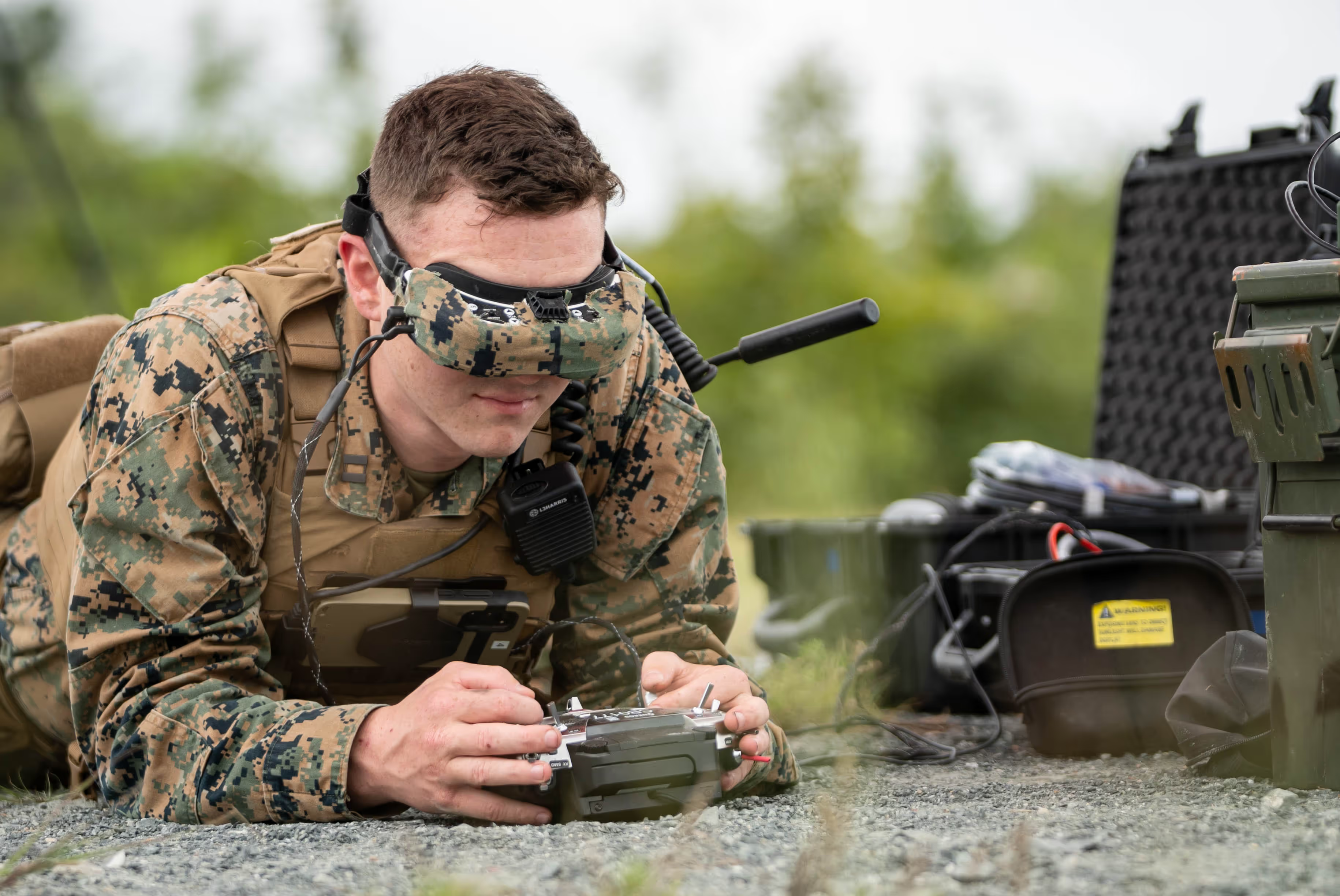
The Marine Corps is halfway through a decade-long project to re-imagine itself for the next generation of warfare, refocusing itself as a seagoing service with Force Design 2030. But the Marines aren't leaving land warfare behind, and will release an updated approach to ground combat in the coming weeks.
As the National Geospatial-Intelligence Agency adopts artificial intelligence into HR workflows, the organization is taking a prudent approach to ensure its workforce doesn't become overdependent on the technology.
The Army has permanently expanded the voluntary retirement request window, allowing eligible soldiers to submit their requests at least 12 months and no more than 24 months before their desired retirement date.

LinkedIn: L*thal
Mission Cultivate: Lethal
It's okay to say what you mean on Mission Cultivate. MC is the free, discreet networking platform for Defense and NatSec where the complex conversation about building the capabilities that arm the free world happens.
See Mission CultivateHeads up: MC is only for verified users in Defense/War & NatSec. Users include gov, industry, academia, vc, and more. Only available to US, NATO, or select major US allies.