Just like old times.

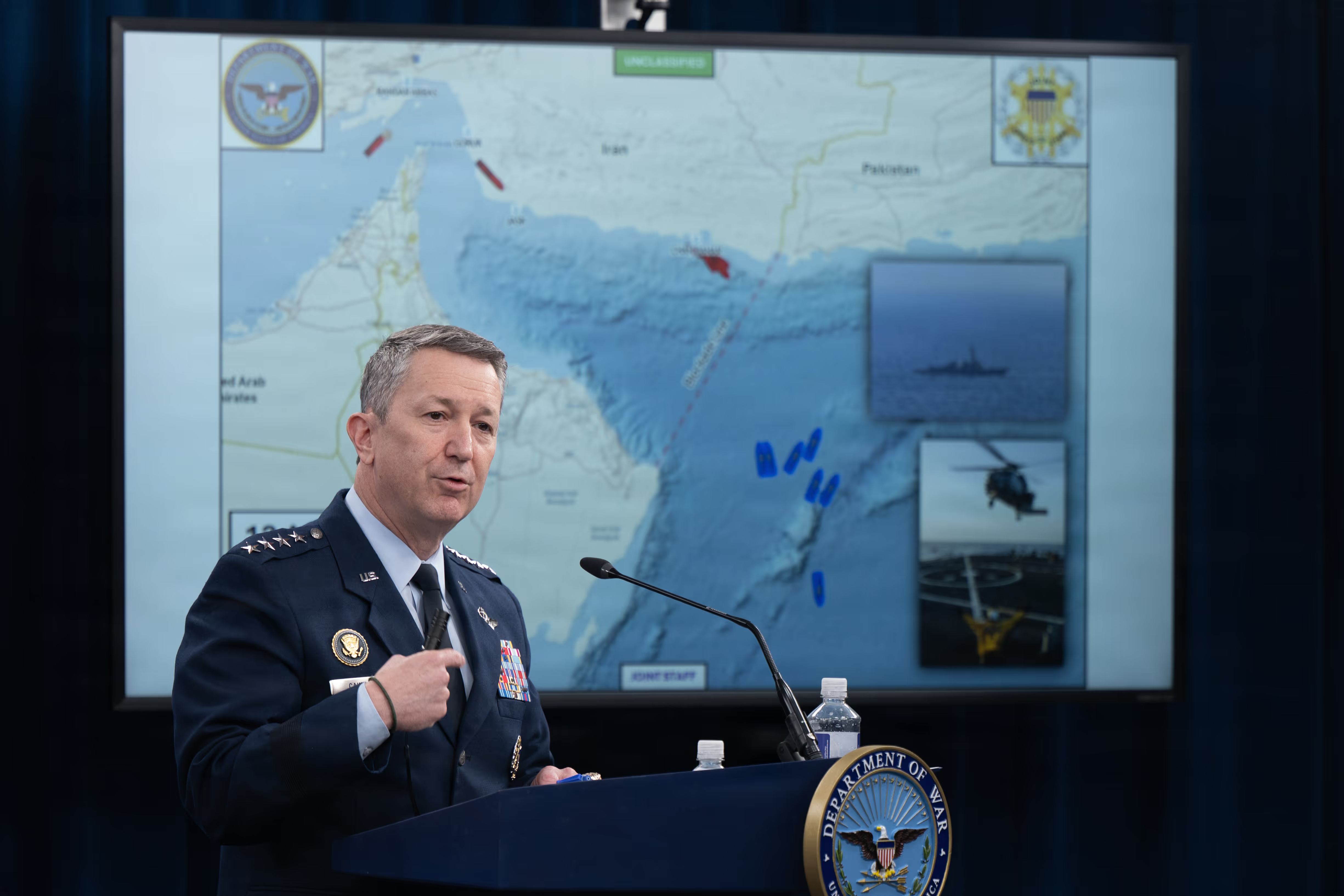

President Trump says the U.S. naval blockade on ships accessing Iran will continue pending a final deal, despite an announcement Friday by the Iranian foreign minister that the Strait of Hormuz was open.
Dig Deeper
Earlier this week, the Pentagon had announced 'Operation Economic Fury' in response to Iran's blockade of the Strait of Hormuz. Read more from Defense Scoop. Also, the conflict is prompting countries to consider their defense spending, with Australia announcing plans to boost its spending to 3 percent of GDP, according to the Defense Post.
Top Headlines
The Pentagon is quietly laying the planning groundwork for a potential U.S. military operation in Cuba, even as the Iran war grinds on, according to recent reports.
Senior defense officials have discussed producing weapons and other military supplies with top executives from several companies, including General Motors and Ford Motor, according to The Wall Street Journal.
The six-page policy memo released on Tuesday calls for a dual design competition between the agencies that is to produce a "nearterm demonstration and use of low- to mid-power space reactors in orbit and on the lunar surface."
In an April 9 memo to senior Pentagon leadership, combatant commanders and defense agency directors, Defense Secretary Pete Hegseth directed the termination of collective bargaining agreements within 24 hours, with limited exceptions for certain categories of employees.
The U.S. Air Force is putting together options to set up a multiyear procurement framework for aircraft and spacecraft development, similar to recent contracts that have been established for munitions replenishment, according to the service's secretary.
A global outage last August affecting millions of Starlink users left two dozen unmanned surface vessels bobbing off the California coast, disrupting communications and halting operations for almost an hour.

A new report from the congressional watchdog found that agencies are not "systematically collecting lessons learned from AI acquisitions." It recommends that DOD, DHS, GSA and VA update their policies to enable sharing and application by other agencies.
Meet Project RED — Recovery Exploitation Drone — an unmanned system that uses AI to find downed enemy drones, and an attached robot arm to pick up those drones and fly them back to the unit to download their data.
Rather than episodic execution, the new JIOP aims to foster a more enduring set of industry experimentation for the XVIII Airborne Division and, officials hope, the wider Army.

On Monday, President Trump signed the Small Business Innovation and Economic Security Act which reauthorizes the Small Business Innovation Research and Small Business Technology Transfer programs that had lapsed since the start of the fiscal year. The authorization implements changes that were agreed to as part of the compromise legislation.
Dig Deeper
Don't expect federal agencies to simply flip a switch back to normal. They will inherit a backlog amid a shrinking contracting workforce. So says Zachary Berenson in a commentary for Federal News Network in which he argues the re-start won't be as easy as it might seem.
Why you should read The MC Post every Saturday morning.
We're bringing back the familiar comfort of unfolding the weekend newspaper and catching up on the headlines, without the tacky popups, scammy ads, or bait-and-switch paywalls that you've come to know and hate. In a world racing toward AI-generated content, The MC Post is curated by people for people. Brought to you by Mission Cultivate—the free networking platform for defense and national security pros. Each week here you'll find the latest in defense and industry to keep you informed ... and more importantly, save you some time. (Subscribe)
Feature Opinions
Ensuring the logistical supply of fuel is paramount for maintaining military operational readiness and effectiveness. Disruption of fuel lines could significantly cripple defense capabilities, argues Lauren Flanagan, CEO and founder of Sesame Solar.
When CMMC preparation is approached as a quick project instead of an overarching operational commitment, weaknesses tend to surface at the most crucial moment. Read more from Mike Nestor, chief revenue officer at C3 Integrated Solutions.
Counter-unmanned-aircraft systems have quietly migrated from a line item in defense budgets to a standalone strategic imperative, says Jurica Dujmovic. And growth is being driven by concurrent demand shocks across three distinct markets: military, homeland security, and commercial infrastructure.
Worth a listen


Scott Kupor built a storied career as employee No. 1 at preeminent Silicon Valley venture capital firm Andreesen Horowitz. So why uproot that to take a job as the director of the federal government's HR agency, the Office of Personnel Management?
Editor's Notes
Let's start with good news: The president has signed the SBIR reauthorization, much to the relief of anxious small business owners across the defense industrial base. As someone who's part of a small business, I feel like I had a genuine "Schoolhouse Rock" experience learning what happens to a bill after it leaves the Capitol and heads down Pennsylvania Avenue. What counts as a business day for Congress? Saturdays, actually — which is a surprising little detail for an organization that seems to prioritize its off time. But at the eleventh hour, President Trump signed the "Small Business Innovation and Economic Security Act" into law, and in turn, the government opened a floodgate of topics it had been chomping at the bit to start. (Pro tip: head over to the SBIR/STTR community on MC to be part of that conversation.) This week, the article that caught my eye was from Defense One about Ukraine's President Volodymyr Zelensky announcing to the world Tuesday that Russian forces had surrendered to Ukrainian robots. Imagine reading that sentence five years ago! The piece points out that the physical environment of combat is shaping the need for autonomy. In this case, the complexity of navigating land terrain over more permissive aerial environments is affecting how militaries approach it. I think it's clear that the trajectory is toward autonomous systems becoming more prevalent on the battlefield, not less. There is plenty of conversation around red lines and ethics as technology gets more advanced, and if you read this publication regularly (or really any defense publication the past few weeks) you need look no further than the ongoing fight with Anthropic. Chaotic as that process is, the conversation about what we value and where we draw lines is playing out in the court of public opinion as much as in the court of law. All that to say, I am confident democracies' internal mechanisms can handle the transference of ethical principles from the battlefield to the blueprint of autonomous systems. I am less confident in our adversaries' ability to do so. I expect societies less bound to public opinion to favor ends over means, meaning we will probably see pretty ruthless tech on the other side of the battlefield. In fact, we already are. CSIS published an analysis of how Russia is employing AI and autonomous systems and found that it "continues to iterate on [their] deployment despite resulting civilian casualties." Russia is already perfectly willing to commit war crimes using humans. I can't imagine removing humanity from the equation leads to anything but worse outcomes. That's not a concern limited to the 'bad guys.' As technology advances and we inevitably meet the moment with our own autonomous systems, what does a future of autonomous-on-autonomous warfare look like that is likely to incentivizes swift, inhuman decisions? More to the point, as much as we may try to remove ourselves from combat, war will always be a clash of people. It's hard to imagine a counterfactual headline where Russian bots accepted surrender of anyone, let along Ukrainians. In the same way we ascribe to a cohenrent law of armed conflict for our own sake, I think now is the time to press harder on discussions about ethics in unmanned systems.
The views represented in this commentary are my own and do not constitute endorsement by the Department of Defense or the U.S. Government.

In the Weeds
Take a deep dive into how Russia is evolving its strategy and incrementally employing AI in autonomous decision making with a number of observations that clarify the need for an ecosystem approach to AI-enabled unmanned systems.
Happening on MC
If you're not on Mission Cultivate, here's just some of what you're missing.
Opportunities
Event Conversations
Communities
Continue Reading
With $70.5 billion in the FY27 budget request for munitions, a handful of analysts said they expect the Pentagon to spread the funding over several years and to fuel multiyear buys.
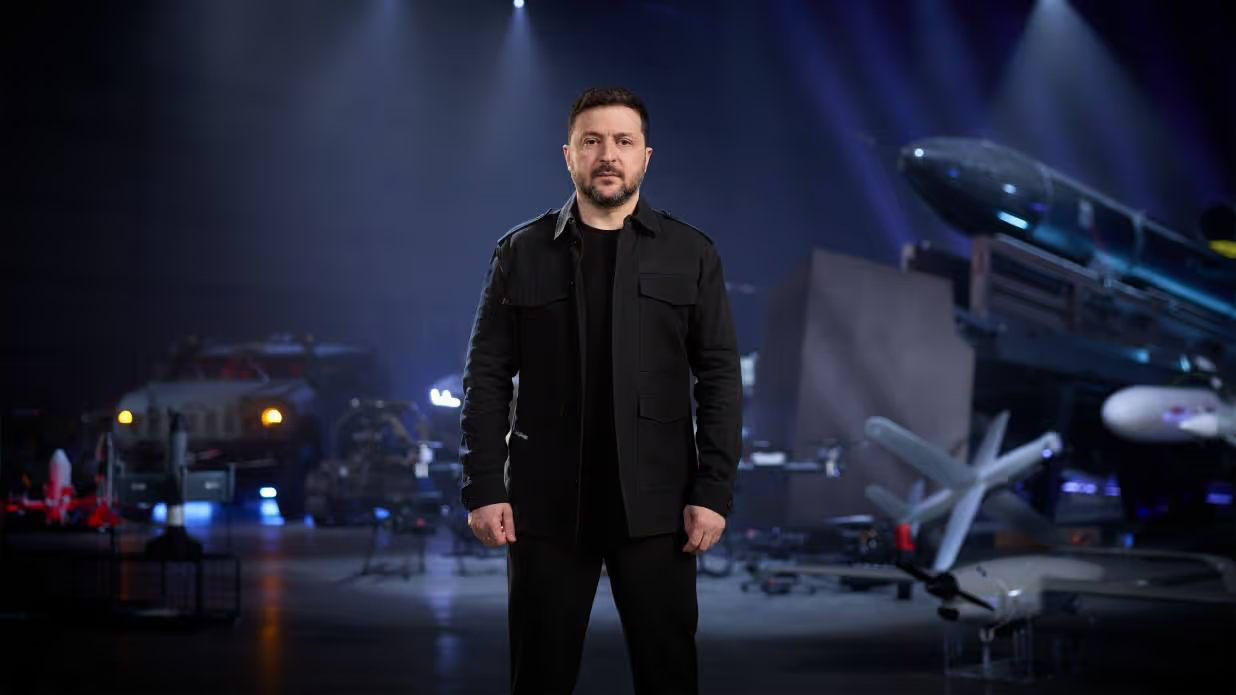
A surprise announcement from Ukraine's President Volodymyr Zelensky Tuesday told the world that Russian troops had surrended to Ukrainian robots, signaling the rising importance of tech on the battlefield. Despite the historic first, communications and navigation still obstruct the future for roboticized ground assault.
Dig Deeper
Ukraine has introduced drone assault units that combine aerial and ground systems, according to the Kyiv Independent. Meanwhile, amid the ongoing conversation around Anthropic being labeled a "supply chain risk," autonomy is very much on people's minds. A retired U.S. Army major general argues the current model — where the government rents access to closed, proprietary systems it cannot fully control — is inadequate for the demands of strategic competition. Read more from Fortune.
Lockheed Martin has floated multiple proposals to upgrade the F-35 fighter as sixth-generation alternatives emerge—but for the time being, it has its hands full manufacturing the existing ones.
Germany has signed a production contract for thousands of autonomous strike drones to be built on its territory for Ukraine, marking its largest move yet into industrial-scale manufacturing of heavy combat unmanned systems.
A DOD CIO social media post on April 10 stated that the office is "driving to prepare networks, data infrastructure and transport capabilities" to meet Sec. Hegseth's vision and direction for modernization.

LinkedIn: B*mb
Mission Cultivate: Bomb
Mission Cultivate is the free, discreet networking platform for Defense and NatSec. Stop censoring yourself and speak freely in the only space made just for you.
See Mission CultivateHeads up: MC is only for verified users in Defense/War & NatSec. Users include gov, industry, academia, vc, and more. Only available to US, NATO, or select major US allies.