Just like old times.

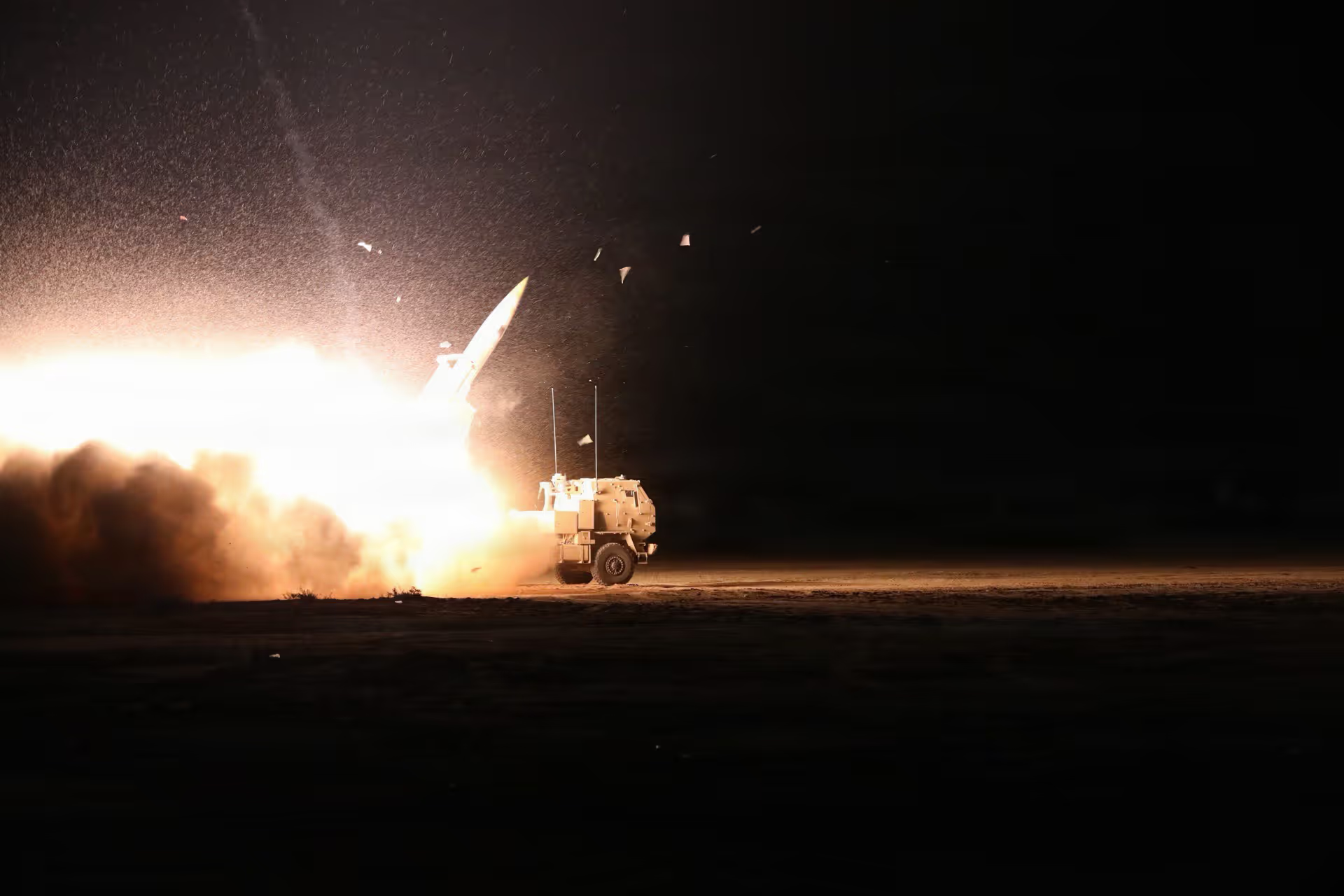

Two weeks into Operation Epic Fury, the Pentagon has said Iran's ability to produce new weapons is "functionally defeated," even as the U.S. and Israel continue to strike a dwindling number of targets. U.S. Central Command said Iranian missile and drone attacks have dropped significantly.
Dig Deeper
See the most recent press briefing on Operation Epic Fury here. Iran continues to threaten shipping through the Strait of Hormuz, with the Pentagon pushing back on the concerns, according to CNBC. Also, earlier this week, the government acknowledged that around 140 troops had been injured in the first ten days of operations, with eight service members being listed in more severe condition, according to Military Times.
Top Headlines
All six crew members of a KC-135 refueling aircraft supporting operations against Iran are dead, the U.S. Central Command said Friday, after their plane crashed in western Iraq. The crash followed an unspecified incident involving two aircraft in "friendly airspace," and that the other plane landed safely.
The company said in a complaint filed in the U.S. District Court for the Northern District of California, that the Pentagon's efforts to blacklist its products are "unprecedented and unlawful," and that they are "harming Anthropic irreparably."
While the Pentagon has signaled its intent to scale technology, field new systems faster, and work more with nontraditional vendors, a new report identifies persistent manufacturing capacity, resourcing, workforce, and modernization challenges that could hinder its ability to deliver on those goals.
One year after the administration's push to purge hundreds of thousands of federal employees, there is now a push to hire unfolding under new rules designed to give the White House greater influence over the government's 2 million-person civilian workforce.
While it is likely the actual budget is higher than the $277 billion the Chinese government claims, Beijing insists its defense spending "remains comparatively modest" for the size of its economy. The increase is in line with recent years.
Lawmakers are pressing the Pentagon for more details about the department increasingly acquiring equity stakes in defense companies as part of the effort to strengthen the country's defense industrial base.

Original contributor Bryon Kroger, CEO of Rise8, says the Department of War doesn't have a technology problem. It has a leadership continuity problem. For more than a decade, the department has tried to replicate Silicon Valley's innovation engine through software factories but come up short. His recommendation: adopt a "Founder mode" mentality.
The Senate has confirmed Lt. Gen. Joshua Rudd in a 71-29 vote, filling vacancies that have been open for almost a year after the unexplained firing of Gen. Timothy Haugh. Sen. Ron Wyden of Oregon had raised concerns about Rudd's lack of experience in signals intelligence and cyber.
In response to findings from the GAO, a senior Pentagon official said the department plans to evaluate and define outside variables that could hinder the defense industry's ability to comply with new standards set by the CMMC 2.0 model.

The Pentagon is moving parts of a Terminal High Altitude Area Defense system from South Korea to the Middle East, ostensible to counter threats from Iran's ongoing response threatening the region. The move has prompted consternation from South Korean leaders and missile defense experts alike.
Dig Deeper
Last week, in response to growing concerns about the rate of weapons expenditure for Operation Epic Fury, major defense companies promised to quadruple production. Despite this, Democrats in Washington are continuing to raise concerns, especially about missile defense systems such as THAAD, which are in high demand in Ukraine and Israel already. Read more from AP.
Why you should read The MC Post every Saturday morning.
We're bringing back the familiar comfort of unfolding the weekend newspaper and catching up on the headlines, without the tacky popups, scammy ads, or bait-and-switch paywalls that you've come to know and hate. In a world racing toward AI-generated content, The MC Post is curated by people for people. Brought to you by Mission Cultivate—the free networking platform for defense and national security pros. Each week here you'll find the latest in defense and industry to keep you informed ... and more importantly, save you some time. (Subscribe)
Feature Opinions
Supporting U.S. forces requires INDOPACOM to modernize networks, data environments and coalition structures, but significant complexities inherent with the region present unique challenges, argue Peter O'Donoghue and Deshawn Bell.
The intersection of technological change and unit economics first seen in Ukraine is now on display in Iran. Precise mass—high-volume use of low-cost drones—will likely become a regular feature of warfare moving forward, argues Michael Horowitz.
As system requirements become more clearly defined, the R&D decisions necessary to establish a credible capability have gained heightened significance and urgency, say Ryan Cooperman and Regan Patrick.
Worth a listen


You don't have to build the perfect software in the lab before you put it on a vehicle because if vehicles could be repaired rapidly in the field, the software team could test more aggressively, fail faster, and iterate without fear. Take a personal tour of the company's history with Byron Boots, co-founder and CEO of Overland AI, as he tells the story of developing ground vehicle technology with DARPA.
Editor's Notes
Our company had the opportunity to participate in a defense tech-focused forum at SXSW in Austin this week. As an aside, Austin is navigating a different 'dispersed' style of its usually massive event that I think nods toward the negative trend hitting many events these days, even beyond the defense space. This forum was put on by Deep Tech Go to Market, whose lead, Jennifer Allen Kay, is a prior (and I hope I'm not too presumptuous, future) contributor to this publication. The series of panels covered could best be distilled into a series of questions: 1) How can we identify problems sooner? 2) How do we quickly identify and surface the right tech to solve those problems? 3) How do we invest and scale to get those solutions into the hands of the warfighter faster? The panels brought the full force of the defense innovation (though some took umbrage at that word) ecosystem to bear, examining it from the lens of founders, operators, investors, accelerators, contracting professionals, and most importantly, warfighters themselves. Listening to the contributors lament the current challenges in the defense space, I noticed a common thread—a sort of addendum to the third question: How do we ensure the quality and propriety of solutions getting into the hands of the warfighter? This manifested in the problem-identification discussion as a question of better informing requirements. It manifested in the tech development discussion more as a need to evaluate solutions in realistic scenarios. And here's the rub in today's environment. There is way more promising tech in need of testing than there are operationally relevant opportunities to employ them. Our team at Mission Cultivate sees this often in the voracious appetite of companies for military exercises that get posted as opportunities on the platform. This isn't just a business problem to solve. The stakes are incredibly high. A solution that meets the environmental constraints of an unrealistic range, or worse, a lab-based set of assumptions, is missing the only metric that matters: where it will be employed in war and who will employ it. One panelist noted that among his kit in Afghanistan, the only reliable communication tool was an Afghan cellphone, because it was the only tool built for the environment. Based both on the discussion in this week's panels and a path-of-least-resistance reasoning, I think the answer to this is quite simply building better connective tissue between the innovators and the requirements holders early enough to surface the best solutions so they can be applied against a very limited number of opportunities. Said more simply, let's build better visibility for better operational relationships. And if any of that resonates with you, make sure to listen to this week's recommended podcast, which is a great example of a technology being built directly around the realistic landscape in which it operates.
Also, I want to give a huge shoutout to Bryon Kroger for contributing to TMCP this week! Don't miss his article that advocates for the DoW to adopt a founder's mentality if it truly wants to capture the magic of Silicon Valley.

In the Weeds
As AI advances and its global impacts deepen, strategic cooperation among states and other actors becomes increasingly important. This report examines what functions such cooperation could serve and how those functions are currently implemented in other domains.
Happening on MC
If you're not on Mission Cultivate, here's just some of what you're missing.
Opportunities
Event Conversations
Communities
Continue Reading
The department is reupping its request for civilian employees to deploy to the southwest border to assist with immigration enforcement operations, with supervisors now facing a stronger push to solicit their staff to sign up for the details.
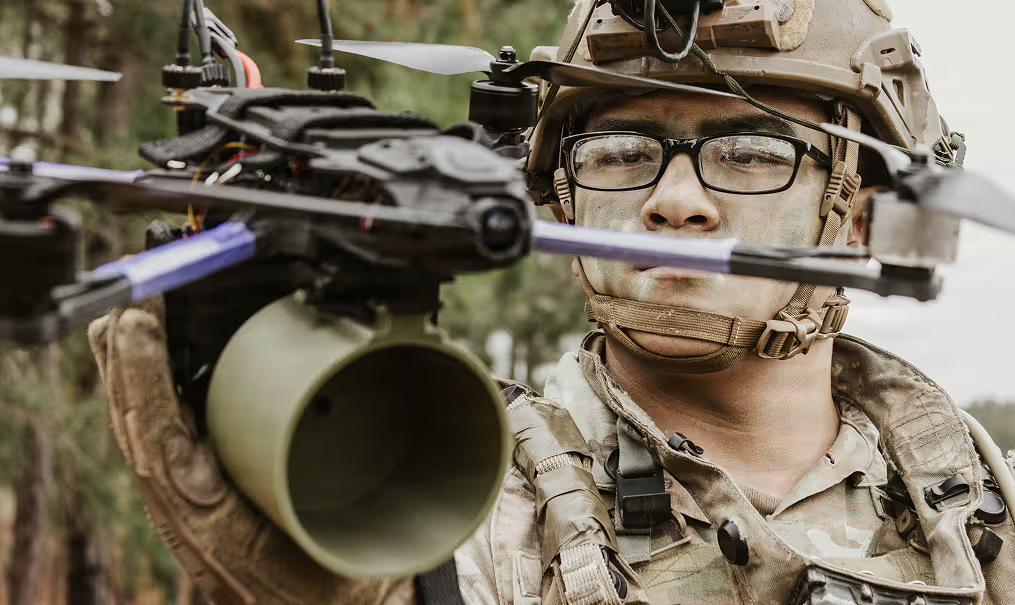
The standings of the first gauntlet phase for the Pentagon's Drone Dominance Program were announced, with the U.K.-based company Skycutter leading the competition. The Pentagon has said it plans to award a total of approximately $150 million in delivery orders after this first phase for 30,000 one-way attack drones.
Dig Deeper
According to the program, companies were scored based on Gauntlet I performance, military operator evaluations, and production and supply chain capabilities. See the leaderboard here. Meanwhile, Defense Daily reported that round two of the competition is likely to include more complex missions for participants.
Researchers at the University of California, Irvine, said they have discovered a critical security vulnerability in autonomous target-tracking drones claimed to have far-reaching implications for public safety, border security and personal privacy.
In the wake of the Anthropic-Pentagon tête-à-tête, the government is considering baseline contract terms for AI systems that would require vendors to grant agencies broad operational rights to integrate and use AI tools within government systems for "any lawful" purpose.
Wearable biometrics, improved science, and more data are changing U.S. Army attitudes toward human performance—particularly how soldiers adapt to the risks of overheating.

LinkedIn: B*mb
Mission Cultivate: Bomb
Mission Cultivate is the free, discreet networking platform for Defense and NatSec. Stop censoring yourself and speak freely in the only space made just for you.
See Mission CultivateHeads up: MC is only for verified users in Defense/War & NatSec. Users include gov, industry, academia, vc, and more. Only available to US, NATO, or select major US allies.