Just like old times.



Sustained military operations, dubbed "Operation Epic Fury," marked their first full week that saw continuous "shock and awe" style attacks that took out Iran's supreme leader on Feb. 28. Attention now turns to what's next as the administration navigates how long operations will continue.
Dig Deeper
Pentagon leadership held several briefing updates throughout the week—get the latest here. Efforts in both the House and Senate to require approval under the 1973 War Powers Act failed, according to NPR. The continuous bombardment and incessant response to Iran's retaliatory missile strikes across the region quickly led to questions about how long the U.S. can sustain operations with its current stockpile of weapons in the theater—a sentiment President Trump pushed back on Tuesday, according to the Hill. By Friday, executives from top major defense contractors had met at the White House and agreed to ramp up production, according to Breaking Defense.
Top Headlines
Two soldiers initially listed as 'unaccounted for' in an attack on a U.S. facility at the Port of Shuaiba, Kuwait, were identified Wednesday. All six soldiers who have been identified were assigned to the 103rd Sustainment Command, based out of Des Moines, Iowa. The incident is under investigation.
Democrats in Congress continued to oppose legislation that would re-open the department amid the ongoing DHS shutdown, even as President Trump announced Thursday that he intends to replace Sec. Noem with Oklahoma Senator Markwayne Mullin.
After months of gridlock, a reform deal moved forward in the Senate to reauthorize the small business seed funding program for five years. The bill now heads to the House for consideration, where it's expected to meet strong bipartisan backing.
The White House Friday released its Cyber Strategy for America, outlining the administration's priorities for cyberspace and calling for unprecedented coordination across government and the private sector to invest in the best technologies.
Top administration officials briefed Congress Tuesday but did not say whether they will ask for supplemental defense funding. But lawmakers expect the president will ask Congress for emergency cash on top of the $150 billion in extra spending it got for this year.
U.S. Southern Command said in a statement late Tuesday that forces had launched operations in a "powerful example of the commitment of partners in Latin America and the Caribbean to combat the scourge of narco-terrorism."
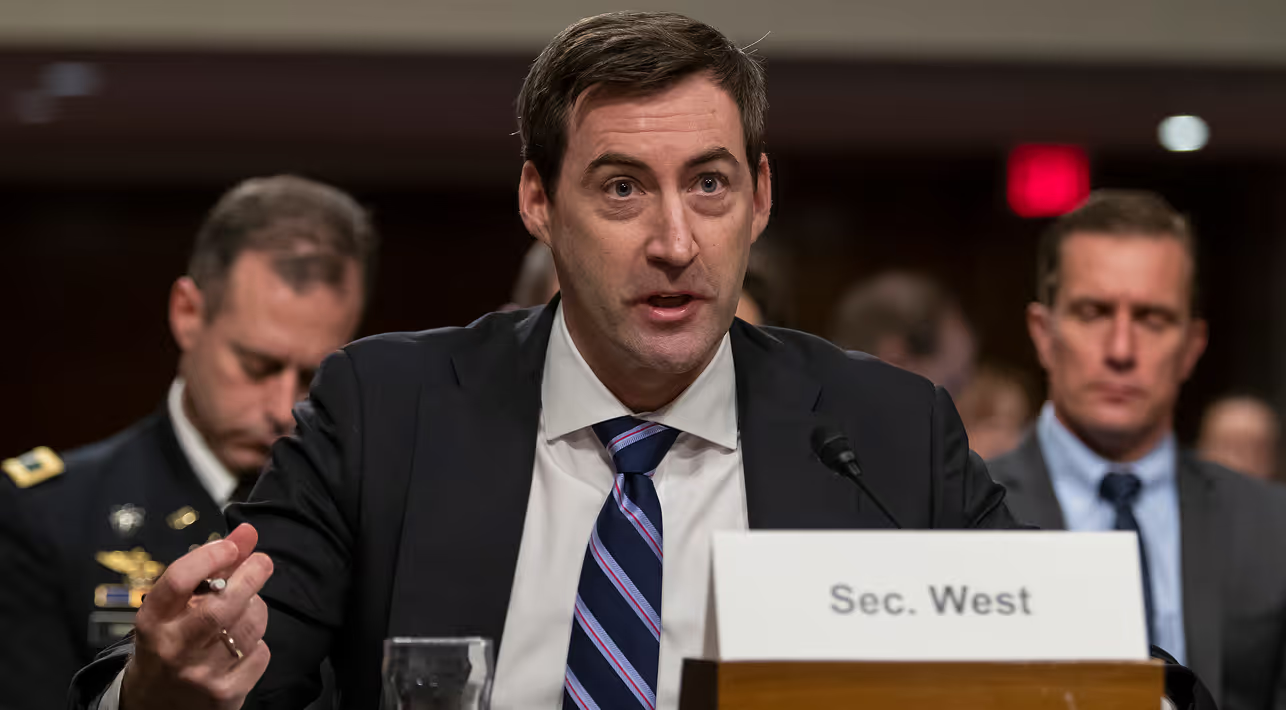
In his first message as the new director of the Pentagon's Defense Innovation Unit, Owen West stated that the organization's efforts will focus on fielding emerging technologies that can keep warfighters out of harm's way and be quickly scaled at low cost.
"We're not just seeking funding," said David Fitzgerald, who is performing the duties of the deputy undersecretary of the Army. "We're seeking creative, out-of-the-box financial and business models that break the mold."
Originally rumored to be caused by Kuwaiti ground-based air defense systems, the Wall Street Journal reported that the three F-15E Strike Eagles shot down Sunday were accidentally targeted by a Kuwaiti F/A-18 Hornet. All six crew members ejected safely.

Amid the Pentagon's harsh response to Anthropic's unwillingness to accede to its demands on ethical red lines, Sam Altman raised eyebrows when he implied OpenAI had reached an understanding on the same concerns. Sources say the real agreement is much softer than he has indicated.
Dig Deeper
Following last week's dramatic stand-off between Anthropic and the Pentagon, NextGov/FCW reported that agencies had begun to comply with the White House's directive to cease using the company's Claude model. By Thursday, Anthropic itself ackowledged the Pentagon had formally followed through on its threat to designate the company a supply chain risk. After backlash, Altman backtracked with an updated agreement that provides stronger guarantees, according to NBC.
Why you should read The MC Post every Saturday morning.
We're bringing back the familiar comfort of unfolding the weekend newspaper and catching up on the headlines, without the tacky popups, scammy ads, or bait-and-switch paywalls that you've come to know and hate. In a world racing toward AI-generated content, The MC Post is curated by people for people. Brought to you by Mission Cultivate—the free networking platform for defense and national security pros. Each week here you'll find the latest in defense and industry to keep you informed ... and more importantly, save you some time. (Subscribe)
Feature Opinions
The U.S.-Israeli war against Iran has been the showcase for missile-defense systems that should be a matter of bipartisan consensus, as basic as deploying radar or anti-aircraft weapons, says Rich Lowry.
The recent debate over Anthropic's engagement with the Pentagon isn't just about corporate ethics—it's about whether we are handing our warfighters tools with the strategic safeties off, argues Mark Munsell, former CTO for the National Geospatial-Intelligence Agency.
Without robust deep conventional strike options, Europe risks vulnerability even in wars that stop short of nuclear escalation, argues Helena Schmidt, a senior analyst in European foreign and security policy.
Worth a listen


In early 2026, Rob Slaughter led Defense Unicorns—the company he founded to transform software delivery for the U.S. military—to become the newest defense tech unicorn on the block, receiving a $1 billion valuation after its Series B round of fundraising and touting a 300 percent increase in adoption year-over-year in military systems.
Editor's Notes
It should come as no surprise the coverage this week is overwhelmingly about the surprise, but not unexpected strikes on Iran. The conflict is highlighting all the major touchpoint of defense industry: weapons system effectiveness, manufacturing and production, budget, new tech, and so much more. I expect the conversation about replenishing weapons stockpiles will be something to keep an eye on. A few weeks back, I included some pointed thoughts about an op-ed from former acting Director of National Intelligence Michael P. Dempsey titled Why Criticism Of The U.S. Defense Industry Misses The Mark. Specifically, I took issue with glazing over what it truly takes for primes to be innovative today. Feel free to go check out Edition 16 for specifics. While I stand by that argument, I am also able to give credit where it is due. There are just some things only the major defense primes backed by massive investment can do. Enter the F-35. No one should be unfamiliar with the complaints about the program's perceived shortfalls: a $2 trillion projected cost (that really needs to be viewed in context), overly complex procurement, delivery delays. At a point, the plane became the rote example of government spending gone wild. If the average American knows about the F-35, this is probably why. But seeing the thing in action this week, I think a lot of people are having to eat a little crow. It was deadly, effective, and untouchable. There were also a slew of F-35 firsts. Israelis had their first air-to-air kill of another manned aircraft. The UK employed it to take down a drone for the first time. Given the plane's role as a connector in the sky, the general effectiveness of the air campaign it led, and its immediate and overwhelming success in theater, we'llk call it an expensive win for America, (and for American industry!)
Keeping it short this week. Next week, our team will be coming to you from SXSW. Stay tuned!
Thinking of those in harm's way,
| Beau Downey, Editor

In the Weeds
The current HR IT landscape is costly, brittle, opaque, insecure, and increasingly misaligned with how the federal government needs to recruit, manage, pay, and deploy its workforce. OPM's new HR 2.0 initiative seeks to replace dozens of agency‑specific solutions, hundreds of interfaces ... but it comes with serious risks.
Happening on MC
If you're not on Mission Cultivate, here's just some of what you're missing.
Opportunities
Event Conversations
Continue Reading
As operations kicked off in Iran, an official confirmed a purported U.S. Cyber Command memo claiming multiple apps were "compromised" and could be revealing servicemembers' locations is fake.

As part of its onslaught of operations against Iran this weekend, U.S. Central Command confirmed that it had employed LUCAS, a its new low-cost, reverse-engineered copy of Iran's Shahed-136 kamikaze drone. It marks the first time the weapons have been used in combat.
Dig Deeper
LUCAS confirmed what acquisition reformers have been arguing for years: speed, cost-discipline, and industrial creativity can beat bureaucracy. Follow the story that runs directly through the conflict in Ukraine and see what this means for future acquisition reforms in this article from Defense Tech and Acquisition. And see what other tech is being employed in combat operations in this article from CNN.
Governments across the world are moving away from pure globalized defense procurement and toward domestic production mandates. The shift is embedded in strategy documents, procurement regulations, and industrial funding programs.
The Pentagon's FutureG office plans to publish the first version of the Open Centralized Unit Distributed Unit radio access network project to GitHub in April to foster innovation in current 5G and emerging 6G networks.
GSA released new requirements in a January update to an "IT security procedural guide" for protecting controlled unclassified information in nonfederal systems and organizations that surprised many.

FREE, GovCloud-Secured Networking Platform for Defense and Industry
With the familiarity of LI, the communities and deep knowledge of Reddit, and the discretion of Signal, the most common thing we hear from first-time users is, "It's about d**n time!"
See Mission CultivateHeads up: MC is only for verified users in Defense/War & NatSec. Users include gov, industry, academia, VC, and more. Only available to U.S., NATO, and select major allies.