Just like old times.



Sec. Hegseth met with Anthropic CEO Dario Amodei on Tuesday to deliver an ultimatum demanding unfettered access to Claude that expired Friday. In a post on Truth Social, President Trump announced a six-month phase out of Anthropic's products.
Top Headlines
The risk of conflict emerging between the two sides remains, with the U.S. having spent recent weeks building up its military presence in the Middle East region amid heightened tensions.
The military intends to spend the entire $152 billion of reconciliation funds from last year's One Big Beautiful Bill Act. Among the planned spending the Pentagon intends to execute quickly is an increase that nearly doubles the Defense Innovation Unit's budget.
Sec. Rubio said the U.S. would conduct an independent investigation before responding after four people on the boat were killed, according to the Cuban Interior Ministry.
The announcement cancelling military attendance at graduate programs at some of the nation's top universities was no surprise and comes after the Pentagon announced earlier in February that it would be ending all military training, fellowships and certificate programs with Harvard.
A reporter reflects on visceral memories of the start of Vladimir Putin's war of aggression on the people of Ukraine that hit a grim four-year milestone earlier this week.
This week, the Pentagon removed Vice Adm. Fred Kacher, who became the director of the Joint Staff in December, returning him to a role in the U.S. Navy. The director of the Joint Staff is a low-profile but influential role within the Pentagon.

After months of gridlock, a compromise bill emerged earlier this week that resolves disputes over how to reform the SBIR program. The agreement, known as the "Small Business Innovation and Economic Security Act," would reauthorize the program for five years.
A Democratic senator on the intelligence committee said in a letter this week he would block President Trump's pick for top uniformed cyber chief because the nominee "is not qualified for this job" and after what the lawmaker characterized as "vague assurances about following the law."
The Defense Department's next-generation background investigation system has made some progress after facing lengthy delays and cost overruns, but the Government Accountability Office warned that the projected schedule to deliver the $4.6 billion program by 2028 still isn't reliable.
Industry FSO helps defense contractors get and maintain their facility clearance without losing momentum. Our team of experienced facility security officer and former DCSA professionals handles the day-to-day security management, audit prep, and ongoing compliance that many small and mid-sized companies don’t have the bandwidth to manage internally. We translate the clearance process into practical steps so our clients can stay focused on delivering their capabilities [...]
Why you should read The MC Post every Saturday morning.
We’re bringing back the familiar comfort of unfolding the weekend newspaper and catching up on the headlines, without the tacky popups, scammy ads, or bait-and-switch paywalls that you’ve come to know and hate. In a world racing toward AI-generated content, The MC Post is curated by people for people. Brought to you by Mission Cultivate—the free networking platform for defense and national security pros. Each week here you'll find the latest in defense and industry to keep you informed ... and more importantly, save you some time. (Subscribe)

The Department of the Air Force will establish around 27 "portfolio acquisition executives" with broad authority and responsibility spanning from requirements to sustainment and support, Air Force Sec. Troy Meink said in a keynote address to kick off AFA’s Warfare Symposium in Colorado earlier this week.
Dig Deeper
Meanwhile, Sec. Hegseth was also in Colorado earlier this week where his message to small businesses in the defense space was to "unleash every company possible." Read more from the Denver Gazette.
Featured Opinions
Limiting American defense industry participation in European procurement programs threatens partnership and weakens mutual security, argue Andrew Puzder, U.S. ambassador to the EU, and Matthew Whitaker, U.S. ambassador to NATO.
Maj. Gen. John Ferrari, nonresident senior fellow at the American Enterprise Institute, argues increased funding, executive backing, and multiyear contracts form a coherent industrial strategy that treats production capacity as a core national security asset.
If the U.S. government believes certain AI capabilities are essential to national defense, that position should be articulated openly in Congress, argues Daniel Castro, vice president at the Information Technology and Innovation Foundation.
Worth a Listen


Hear from the Dean of the Mitchell Institute, retired Lieutenant General Dave Deptula, for an update of the major news from the sidelines of this week's AFA Warfare Symposium in Denver. He says the Air and Space Forces are both at the point where they can no longer squeeze more efficiency—they simply need more resources to reverse the decline in force structure.
Editor's Notes
Obviously, I have to start this week with a recognition of the much welcomed news of finally seeing some movement on the SBIR/STTR program that has been stalled for so long we can actually measure it in government shutdowns. It’s not across the finish line yet, so spit over your shoulder or throw salt or whatever it is you do to ward off the bad things, but when this deal for a five year extension of the program passes, it will be a huge relief to small businesses that drive American innovation for the federal government that have been left in limbo during a protracted policy fight. Let’s get this done.
In other news this week, AFA held its twice-a-year get-together in Colorado that was, shall we say, less than crowded. My team is based out of Denver, so every time this show comes to town, we have people there. I personally have attended several AFAs at the Gaylord in Aurora. I remember the first one several years back well. It was busy. Very busy. If you go to AFA, you know you better get your event badge early and your coffee somewhere other than the main Starbucks line because when thousands of people pour into that space, it’s a madhouse.
This year, however, it was jarringly sparse. Apparently this iteration was a continuation of last year’s low attendance trend that resulted from the Pentagon limiting who can travel for these kinds of events. I’m not going to comment on the wisdom of such a policy, only on the very real effects on the intended outcome of events. Like it or not, in-person events have become the points of connection that drive efforts forward in the defense industrial space. For many companies—especially the smalls—they are the best hope of connecting with a senior decision maker or a potential partner. Events are where real connections lead to real conversations and, to use a tired phrase, actually get shit done. There’s a reason companies pay exorbitant entry fees, and it’s not the gourmet boxed lunches or the great view from the back corner of the expo hall.
So the question becomes: What’s next? If in-person events don’t have the monopoly on connection, then where do we go to fill in the gaps? It’s not just about seeing a face. If that were the case, Teams calls would be more effective than they have proven out to be. The secret sauce, if you will, of the defense industry event is the breaking down of barriers and the actual, tactile human aspect of it all. It’s the quiet side conversations in the halls. The happy hours where people actually talk like people. If we’re going to augment events with more cost-effective methods, as seems to be the vector at least for the current administration, then whatever we add to the mix needs to capture that uniquely human element.
And speaking of humans, what a great segue to the top news of the week in defense land: Anthropic’s spat with the Pentagon. At the time I’m writing this, Anthropic still has a few hours on the clock to accede to Sec. Hegseth’s demands. I doubt there is much I could add that dozens of articles have not already articulated. Suffice it to say that I think this story has captured everyone’s attention not just because of the high drama of it all, but also because it is forcing a conversation about where we as humans stand as AI moves ever faster. That conversation is worth having, and I expect we will hear much more about it in the coming weeks and months.
Happy reading this week,
| Beau Downey, Editor
The views represented in this commentary are my own and do not constitute endorsement by the Department of Defense or the U.S. Government.

In The Weeds
Few people know the nuts and bolts of AMC and its mission better than Michael "Mini" Minihan, a retired Air Force general who led the command from Oct. 2021 to Nov. 2024. In a 45-minute interview, Minihan offered his insights on that and a whole host of other topics.
Happening on MC
If you're not on Mission Cultivate, here's just some of what you're missing.
Opportunities
Event Conversations
Continue Reading
The kit is designed to speed how the service develops and acquires new technologies by prioritizing solutions that demonstrate measurable, outcome-driven results, Navy CTO Justin Fanelli said Thursday.
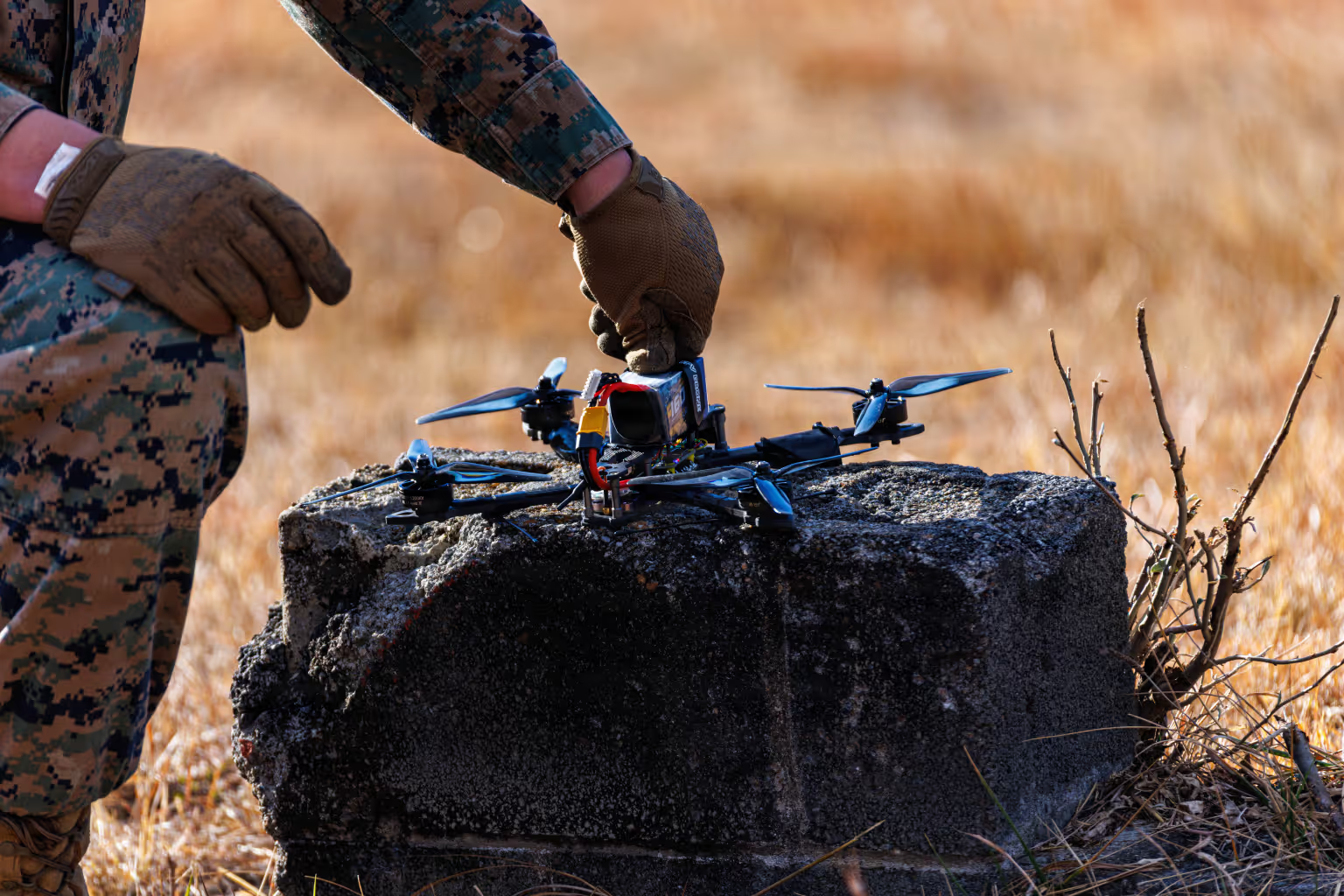
JIATF-401, the Pentagon's task force leading its Replicator 2 initiative, announced that the new online platform will be hosted on the common hardware systems electronic catalog and will "revolutionize how the War Department and its interagency partners acquire critical counter-UAS technology." The electronic catalog lists over 1,600 items and is available to War Department and interagency partners via CAC-enabled access.
Dig Deeper
Task & Purpose reported that the Army crowned the winners of its first drone competition in a new annual event that brought teams from across the Army to participate in races and simulated hunter-killer missions.
Leo Garciga, the Army’s CIO, said the move toward enterprise services is changing the culture of system development to be more adaptable.
Rep. Nancy Mace said the Skills-Based Federal Contract Act will eliminate a "paper ceiling" and give agencies access to a broader base of tech talent.
A former U.S. Air Force officer has been arrested and accused of secretly training Chinese military pilots for combat missions overseas, federal prosecutors said.

No-cost GovCloud-Secured Networking Platform for Defense and Industry
While the DIB scrambles to build "just 1 more" AI-matching marketplace, we're doubling down on the human connections that actually make Defense happen.
See Mission CultivateHeads up: MC is only for verified users in Defense/War & NatSec. Users include gov, industry, academia, vc, and more. Only available to US, NATO, or select major US allies.