Just like old times.

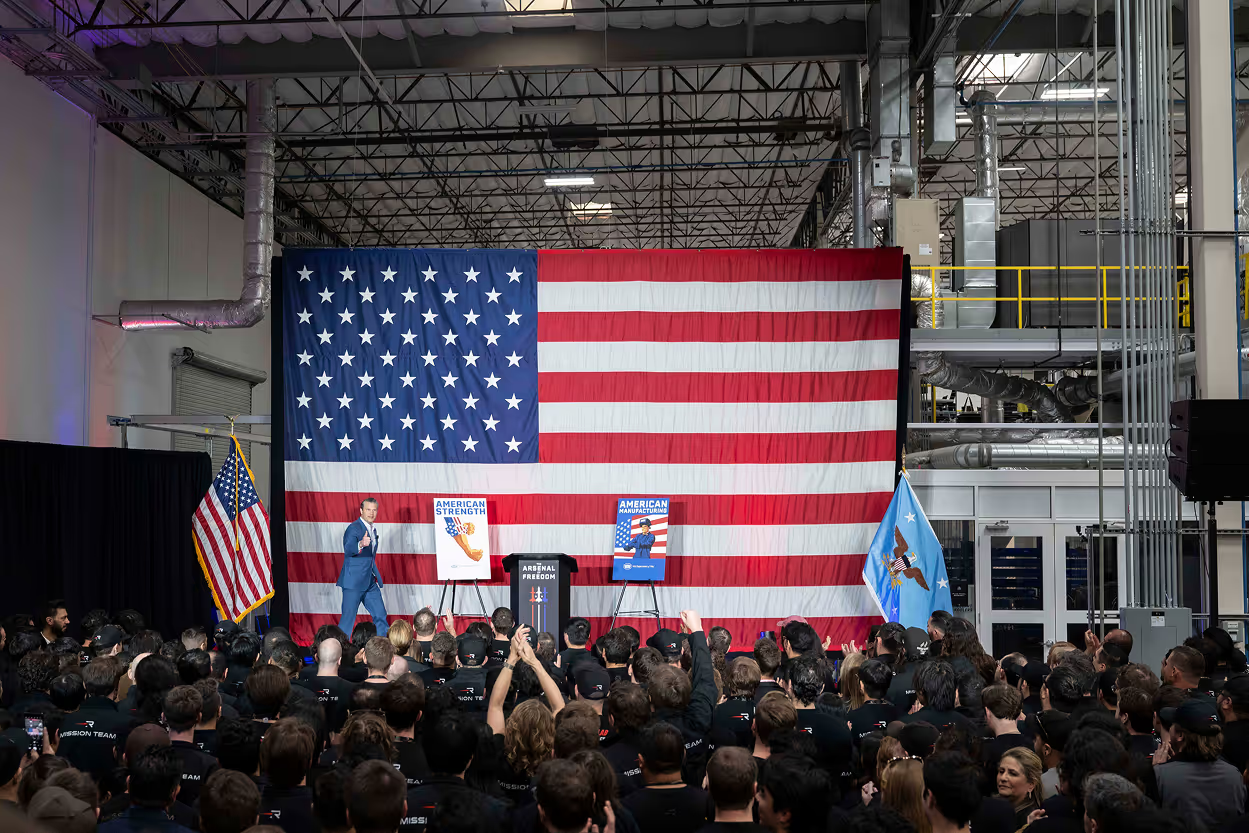

Sec. Hegseth announced DARPA, DIU, SCO, and CDAO will now operate under Emil Michael's office as a unified "innovation operating system." A series of memos laid out seven "Pace-Setting Projects," modernization of Advana, and a new War Data Platform. The changes mark a sharp break from risk-averse policies, emphasizing operational independence, rapid execution and mission-focused innovation across the DoW.
Dig Deeper
In his speech, which you can watch in full here, Hegseth also announced the department will integrate Grok—Elon Musk's chatbot for X—into the military's networks, according to reporting from the Guardian. Read the memos outlining the changes to the innovation ecosystem here.
The world, and especially the Middle East, was on edge this week as it looked like U.S. military intervention in Iran was imminent. The current approach is to wait and see, officials said Thursday.
Legislators are still trying to navigate funding priority disagreements between both houses of Congress as the end-of-month deadline draws nearer. The House appropriations defense subcommittee chair, Ken Calvert, said he's hopeful the final version will beat the deadline.
Tensions have increased as NATO allies signal their frustrations with U.S. designs on Greenland. Copenhagen has disputed President Trump's justification for wanting to control the island.
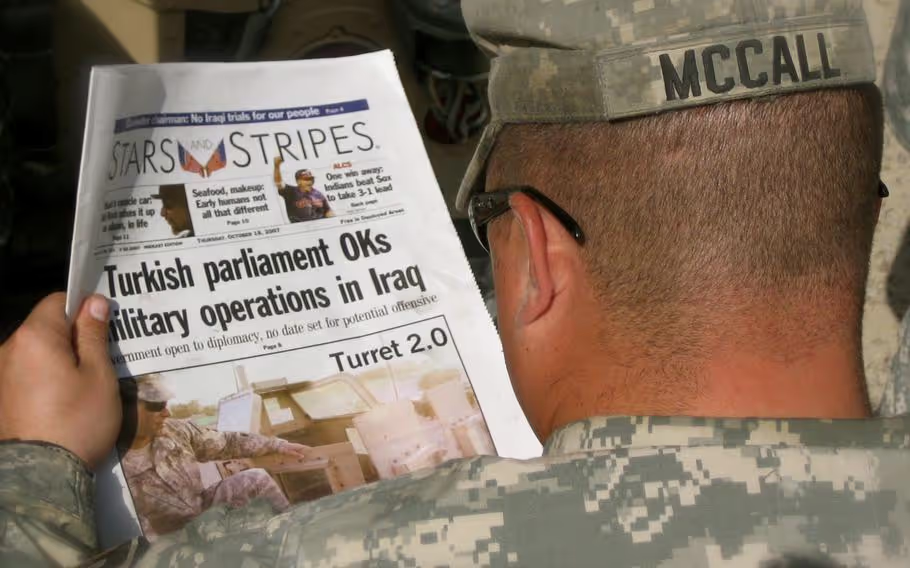
The Pentagon said on social media Thursday it would take over editorial content decision-making for Stars and Stripes, a move the government-funded outlet says would challenge its longstanding independence.
The DoW launched a $100 million prize challenge to accelerate development of an Autonomous Vehicle Orchestrator—a layer of technology that can translate a battlefield commander’s intent from voice, text, and haptic input into machine execution.
The Pentagon has reportedly been testing a machine believed to produce pulsed radio waves that may be linked to a strange set of symptoms U.S. officials first experienced a decade ago.
"We need to make a dent into that," Chief of Naval Operations Adm. Daryl Caudle said of the Navy's 355 ship requirement. "I think the chairman, and I think the secretary of Navy and the secretary of War agree that that the Navy needs a budget commensurate with its mission set."
After the Protect America’s Workforce Act cleared the House, federal unions have been pushing for the Senate to take up the bill’s companion legislation.
The military balance is "shifting dramatically and rapidly" in the Indo-Pacific, and "provocative military activities are intensifying" in the western and southern Pacific, Japan’s minister of defense said this week.
Sec. Hegseth announced that Cameron Stanley will be the Pentagon’s next CDAO. Stanley comes to the job after leading digital transformation efforts at Amazon Web Services.
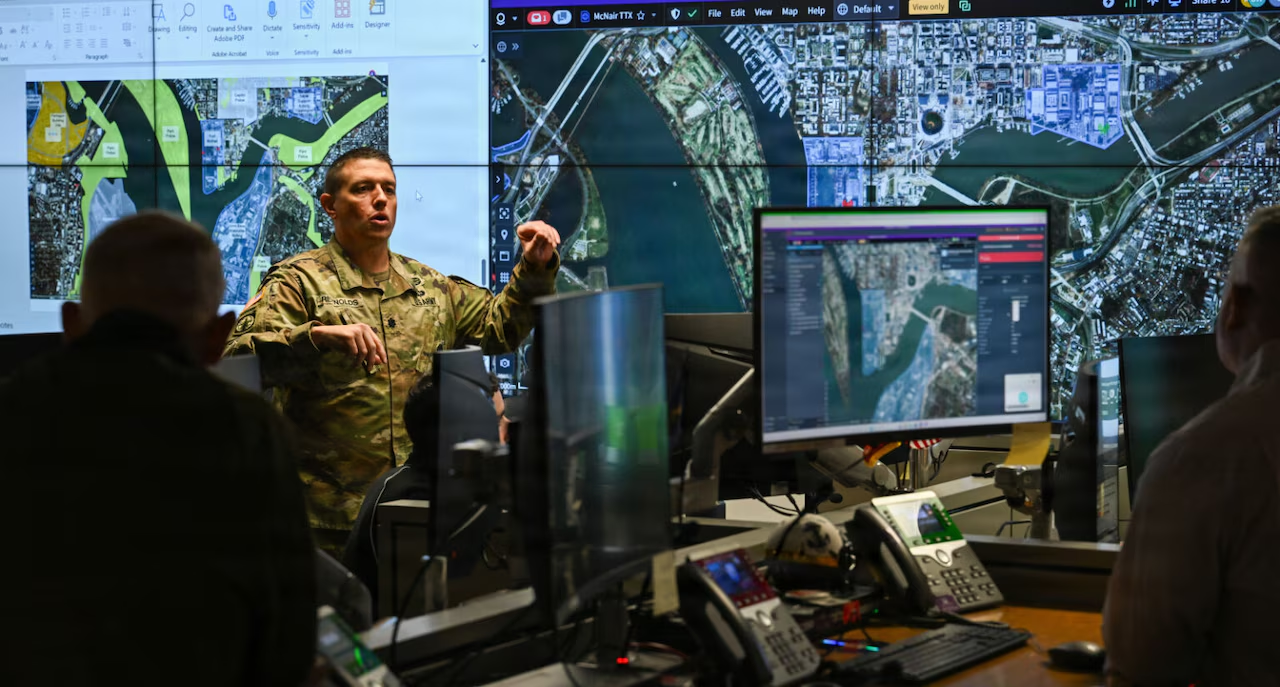
The acquisition—the first under the new phase of the Pentagon's drone initiative—provides JIATF 401 with enhanced capabilities to counter the growing threat posed by sUAS. "The task force is focused on a whole-of-government approach," said Army Brig. Gen. Matt Ross, the task force's director.
Dig Deeper
Breaking Defense reported that Brig. Gen. Ross traveled with Army Secretary Dan Driscoll to the United Kingdom to establish ground rules for sharing intelligence on drone and counter-drone operations. Driscoll said the "end state" of such arrangements would make the US and its allies stronger in a future conflict where they would have to fight together.
Why you should read The MC Post every Saturday morning.
We’re bringing back the familiar comfort of unfolding the weekend newspaper and catching up on the headlines, without the tacky popups, scammy ads, or bait-and-switch paywalls that you’ve come to know and hate. In a world racing toward AI-generated content, the MC Post is curated by people for people. Brought to you by Mission Cultivate—the free networking platform for defense and national security pros.
Feature Commentaries
Logan Whitehair, a visiting research fellow from the Horizon Institute for Public Service, examines the data that shows where R&D efforts for defense technologies are leading to commercialized successes.
To make it a genuine force multiplier, the department must rapidly iterate on its design, focusing on the features that directly impact operational tempo and decision-making, argue Sean Rugge and Dr. Silas Schaeffer.
That future is not about replacing every traditional manufacturing process. It's about expanding the toolbox and using the right approach for the right application, according to Rob Higby, CEO of Continuum.


Join Elbit America's supply chain director, Bo Birdwell, to discuss the company's latest open letter to suppliers regarding CMMC. Elbit's letter doesn't mince words: CMMC is here, and the time to act is now.
Hear from CFR's visiting military fellows as they talk through recent changes to defense policy, such as training posture, budget and acquisitions, to meet the current moment.
Editor's Notes
This week showed the U.S. Department of War is clearly signaling a strategic pivot in how it develops and deploys emerging technologies. Let me expand on our top story this week. The department’s announcement that it will consolidate key organizations, including the Defense Innovation Unit, Strategic Capabilities Office, DARPA, and CDAO under its Chief Technology Officer, all address longstanding fragmentation that, in my opinion, has slowed innovation. This realignment is not merely structural; it emphasizes operational speed, mission-focused outcomes, and a real commitment to its AI-first strategy, all of which mark a departure from historically risk-averse policies. And the leadership choices of Owen West at DIU and Cameron Stanley at CDAO reinforce the department’s intent to blend operational experience with commercial technology expertise.
Initiatives like the seven "Pace-Setting Projects" and the War Data Platform are particularly interesting. They illustrate a broader commitment to rapid experimentation and reduced bureaucratic barriers. Of note, the $100 million Autonomous Vehicle Orchestrator Prize Challenge we highlighted this week, which was jointly launched by DIU and the Defense Autonomous Warfare Group, shows a practical application of market-driven innovation. And a welcome one at that. By incentivizing iterative development and linking commercial solutions directly to operational needs, the department is signaling a preference for scalable, commercially viable technologies rather than bespoke programs. If that’s in your wheelhouse, make sure you take a look!
The significance of these changes extends beyond the walls of the Pentagon. The broader technology ecosystem, including the $142.5 billion U.S. space economy, is evolving as younger workers drive innovation. Check out the newly released Census Bureau data on employment, earnings and job creation in this week’s "More In Depth" section, which provides more than just numbers. There are actionable insights for both industry and policymakers, and real opportunities for collaboration and talent acquisition as a consequence of the changing landscape.
One last one I want to highlight is the interesting (let’s be honest, unsettling) report that the long-discussed ‘Havana Syndrome’ may have some merit. The DoW is testing a radio wave device potentially linked to it. There is still need for careful evaluation, but it’s also a good reminder of the tension between experimentation and ever-evolving needs at the operational level. I’ll be interested to see where this one goes.
Overall, I’m struck this week by the coherent strategy of it all: The DoW is consolidating authority, truly leveraging commercial tech, and accelerating experimentation. Agree or disagree with the direction, there is fast movement to operationalize the department’s strategy on multiple fronts. For those of us outside the government trying to support, the signals are clear that engagement opportunities across the public and private sectors will be laser-focused on delivering mission-critical capabilities at speed. What a time to be involved in contracting!
| Dr. Dolores Kuchina-Musina, Guest Editor

More In Depth
The growing "space economy," valued at $142.5 billion, is being driven by younger workers. This first-ever look at national quarterly workforce indicators provides economic data on employment, job creation, and earnings.
Despite several shocks in the past year, the global economy saw strong growth in 2025. It faces major challenges in the year ahead, from the AI surge to the global response to new U.S. tariffs.
The lessons from World War II’s "Arsenal of Democracy" point toward multi-year, demand-backed contracts and private-sector capacity to expand munitions and equipment production far beyond the current capacity of the defense industrial base.
Happening on MC
If you're not on Mission Cultivate, here's just some of what you're missing.
Event Conversations
Continue Reading
An IG report says the military has failed to keep up with what quantum computers might realistically do for national defense in the near term—a gap that carries implications for investors.
President Trump sent jolts through the defense industry last week by mixing talk of a $1.5 trillion defense budget with a blunt warning to contractors: Prioritize production and readiness, not Wall Street.
Nearly a decade since GSA introduced the final rule, the agency will require transactional data reporting for all multiple award schedule purchases, despite strong caution from a watchdog that believes the program isn’t ready for full operation.
The department has created an office to operate drones and counter bad ones, with millions of dollars already slated to protect upcoming high-profile mass gatherings across the U.S., agency officials said Monday.
The new body fat expectations range from 18% to 26% for men and 26% to 36% for women, according to a new memo. Under the new rules, all service members will be evaluated twice per year.
The contract was awarded by AFLCMC and is intended to enable the Air Force to meet the Pentagon’s broader goal to shift to zero-trust cybersecurity practices across the enterprise.

Find the others.
Mission Cultivate is the free, discreet networking platform for Defense and NatSec. Connect with similar missions and find communities of common concern in the only space made just for you.
See Mission CultivateHeads up: MC is only for verified users in Defense/War & NatSec. Users include gov, industry, academia, vc, and more. Only available to US, NATO, or select major US allies.