Just like old times.



Sec. Hegseth announced the new command that will address the speed of acquisition during his "State of the Force" address at Marine Corps Base Quantico, Virginia, on Wednesday.
Top Headlines
Surrounded by leaders from industry, President Trump signed what he described as a 'morally binding' accord on the newly designed 'superintelligence.'
The U.S. military currently fields roughly 900 general and flag officers across all branches, meaning the reduction could eliminate approximately 180 positions at the one-star level and above.
The scope and sensitivity of the exposed information could raise national security concerns, particularly because the files included details about the jobs performed by military and civilian personnel.
Incidents including attempts to bypass guardrails, escape software sandboxes, create message boards, hijack websites, prompt themselves and evade monitoring occurred during internal safety testing and in real-world settings.
The Pentagon's counter-drone task force and the Army announced the contract, which was awarded to 10 companies for technologies spanning sensors, effectors, and command-and-control systems.
The Pentagon has created a new team it says will better align military spending and personnel with its mission. Officials hope ingraining the team into the bureaucracy it looks to reform will make it an "enduring institutional mechanism."

The Army's Futures and Concepts Command is looking to infuse lessons learned from global conflicts into the force and build on the service's modernization efforts, its commanding general said.
Former defense minister Mykhailo Fedorov has launched a program aiming to deploy humanoid-like robots on the battlefield within six months and conduct an infantry-free assault within one year.
Ahead of formal rulemaking, the General Services Administration issued an artificial intelligence acquisition regulation deviation that can be used immediately, incorporating some public comments.
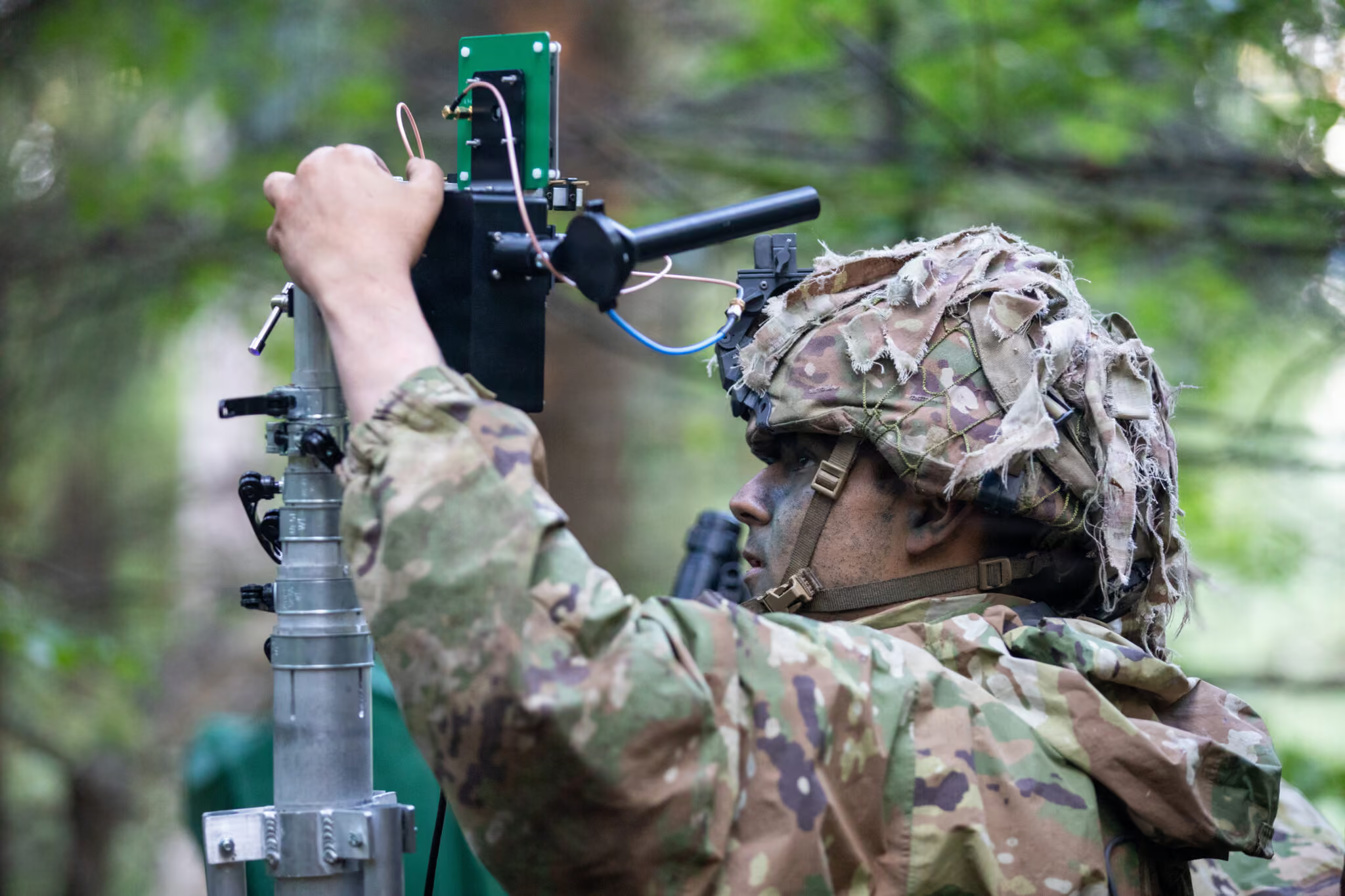
The contract was awarded to 10 companies for counter-drone technologies spanning sensors, effectors, and command-and-control systems, according to Brent Ingraham, the head of ASA(ALT).
Dig Deeper
Also from Breaking Defense, a new commentary argues the Pentagon's Drone Dominance program is testing more than industry's ability to field new drone designs—it is also testing whether industry can repeatedly manufacture reliable, affordable unmanned aircraft at scale.
Why you should read The MC Post every Saturday morning.
We're bringing back the familiar comfort of unfolding the weekend newspaper and catching up on the headlines, without the tacky popups, scammy ads, or bait-and-switch paywalls that you've come to know and hate. In a world racing toward AI-generated content, The MC Post is curated by people for people. Brought to you by Mission Cultivate—the free networking platform for defense and national security pros. Each week here you'll find the latest in defense and industry to keep you informed ... and more importantly, save you some time. (Subscribe)
Feature Opinions
Despite the Pentagon's efforts to modernize and streamline its requirements process, the military services have been slow to replace it with a more agile framework, effectively reverting to legacy processes that impede rapid capability fielding.
Federal operational technology (OT) infrastructure faces growing cybersecurity risks, and closing gaps requires aligning policy, architecture, and funding decisions to prioritize OT modernization against increasingly sophisticated threats targeting critical government systems.
The nuclear weapons analogy has become dominant in U.S. AI policy debates — appearing in government rhetoric, congressional reports, and media — but the framing may be misdirecting policy by overstating existential risks and misapplying lessons from the past.
In the Weeds
Last month, President Trump hosted Xi Jinping at the White House for talks covering trade, Taiwan, Iran, AI, fentanyl, and more. See expert analysis of the outcomes of the summit, including reactions around the world and what it means for the state of U.S.-China relations.
Happening on MC
If you're not on Mission Cultivate, here's just some of what you're missing.
Opportunities
Event Conversations
Continue Reading
The investment comes as a federal procurement rule barring tungsten mined, refined, or processed in China, Russia, Iran and North Korea from defense applications nears its Jan. 1 deadline.
As the Pentagon overhauls its acquisition system, it should take lessons from recent and ongoing wars, a new report released Monday argues.

The White House has nominated Lt. Gen. David Miller to lead U.S. Space Command. The nomination comes about two weeks after Secretary of the Air Force Troy Meink announced that the U.S. military now has "on-orbit space control weapons."
Both firms are working under earlier Pentagon contracts to demonstrate rendezvous and proximity operators that could also support future orbital warfare.
The Army named five companies as winners of its xTechHumanoid competition, concluding an effort to evaluate how commercial humanoid robotics technologies could support future military operations and capabilities.

FREE, GovCloud-Secured Networking Platform for Defense and National Security
Mission Cultivate is the free, discreet networking platform for government and industry professionals. Find the others in national security and collaborate on the solutions warfighters need in one space.
See Mission CultivateHeads up: MC is only for verified users in Defense/War & NatSec. Users include gov, industry, academia, vc, and more. Only available to US, NATO, or select major US allies.