Just like old times.

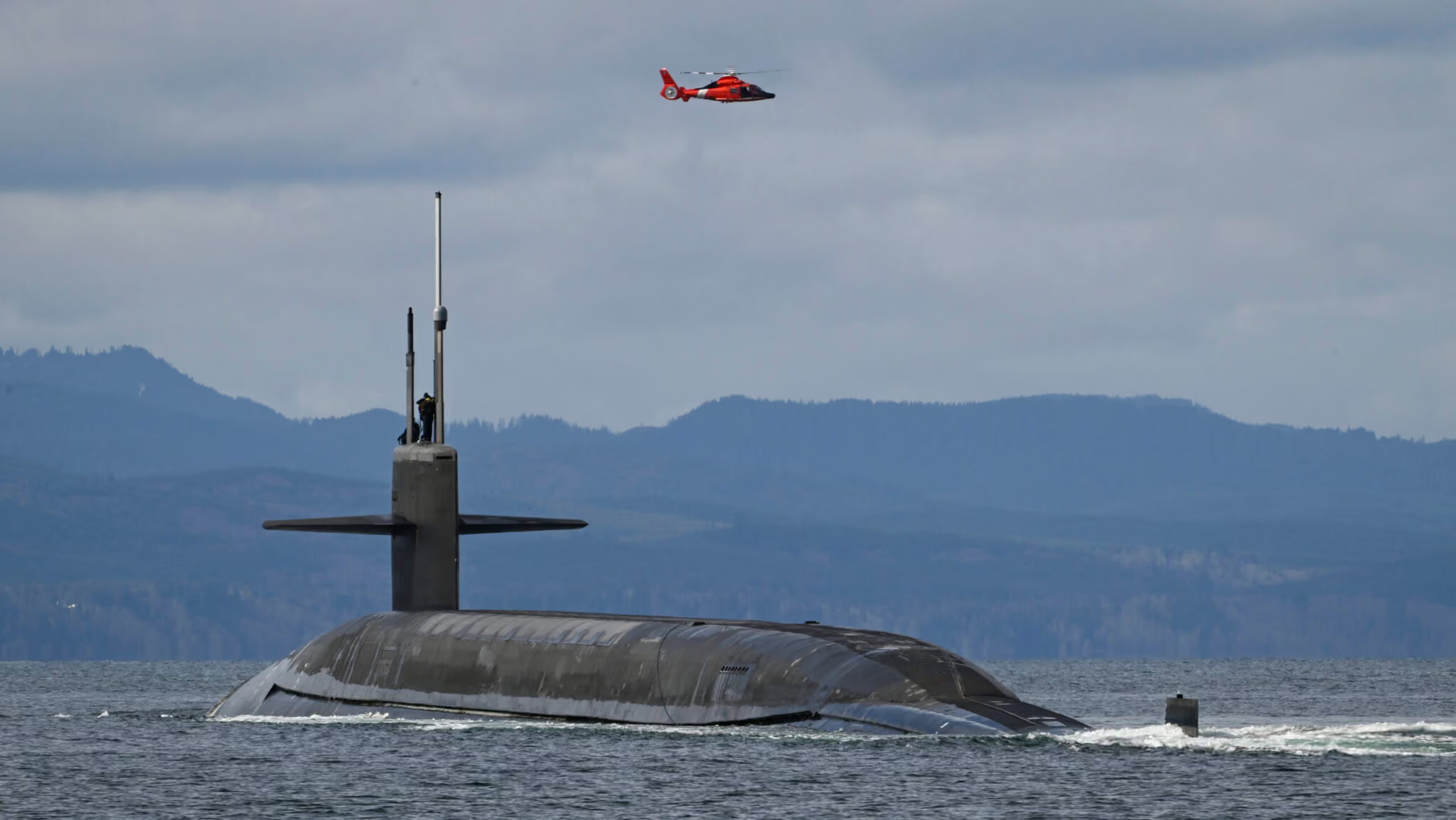

The White House has released a National Security Science & Technology Strategy that formally designates undersea systems, outer space capabilities, and artificial intelligence as the top military technology priorities. The strategy also tags quantum computing and biotechnology as significant but longer-term areas requiring sustained attention.
Dig Deeper
From Defense One, explore what the new strategy means for the military, deterring China, and the future of AI. Also, the acting secretary of the Navy appointed M. Barry Tanner to oversee the Navy's $12 billion information technology portfolio and implement the department’s Information Superiority Vision 2.0. Read more from Military.com.
Top Headlines
In a surprising move, acting Army chief of staff Gen. Christopher LaNeve directed a drone assault battalion away from its unmanned systems-centric mission and back toward a core airborne infantry role to get "back to basics" according to reporting from the Wall Street Journal.
The Small Business Administration is proposing to simplify its NAICS code size standards, reducing the total number of size standard categories from nearly 1,000 to 338, a change it estimates would make approximately 114,000 additional companies eligible for federal small business contracts.
Deputy Secretary of War Steve Feinberg signed a new directive aimed at resetting Pentagon expectations for supplier cost and pricing information, pushing contractors to provide greater pricing transparency and potentially enabling a direct software link for data sharing between suppliers and the department.
The Defense Innovation Unit's Bridge Program is executing a targeted strategy to eliminate bottlenecks and drive systemic reform within the U.S. defense industrial base, aiming to accelerate production capacity and modernize supply chains for military needs.
The Pentagon on Friday moved to fire the publisher and the editor in chief of Stars and Stripes, the U.S. military news outlet partly funded by American taxpayers, as well as a reporter who covers the Middle East, for "insubordination" after an appearance on CBS Sunday Morning.
.avif)
In early June, the White House issued an executive order aimed at accelerating the federal government’s adoption and secure use of advanced AI. The directive calls on agencies to prioritize cyber defense, expand programs that put AI-enabled defensive tools to work, and facilitate access to frontier models. But encouraging agencies to adopt AI is only half the battle. The harder part is creating the conditions to put those capabilities to work. AI moves fast. The most capable models from OpenAI, Anthropic and Google can change within weeks. Government software authorization operates on an entirely different timeline. An authorization can take months, if not years. An agency restricted to already-authorized models can find itself effectively going back in time compared with what is available commercially.
Inconsistent identification and marking of Controlled Unclassified Information (CUI) remain a persistent obstacle for the Cybersecurity Maturity Model Certification (CMMC) program, with most organizations citing it as a key challenge to effective implementation across the defense industrial base.
Army Cyber Command's Lt. Gen. Christopher Eubank revealed that an AI task force is developing autonomous agents designed to hunt threats within DOWQ networks, while currently keeping humans responsible for all risk decisions as the team establishes guardrails before allowing agents to operate independently.

The U.S. and South Korea will shorten their annual joint military drills and scale back field training exercises following a direct order from President Trump to reduce American participation, potentially affecting readiness and alliance commitments on the Korean Peninsula.
Dig Deeper
Victor Cha argues there is coherent logic underlying the Trump Administration's divergent approaches to Iran and North Korea's nuclear programs, with the two cases treated under distinct diplomatic and deterrence frameworks despite appearing contradictory. Read more from CSIS. North Korea responded to the news with a slew of rocket launches. Read more from Military.com.
Why you should read The MC Post every Saturday morning.
We're bringing back the familiar comfort of unfolding the weekend newspaper and catching up on the headlines, without the tacky popups, scammy ads, or bait-and-switch paywalls that you've come to know and hate. In a world racing toward AI-generated content, The MC Post is curated by people for people. Brought to you by Mission Cultivate—the free networking platform for defense and national security pros. Each week here you'll find the latest in defense and industry to keep you informed ... and more importantly, save you some time. (Subscribe)
Feature Opinions
China's People's Liberation Army has publicly maintained that AI cannot replace human commanders, reserving final decision authority for human officers, but Xi Jinping's broader military modernization push is testing that doctrine as the PLA integrates AI into command-and-control systems to compress observation-to-action timelines.
Greg Garcia, CTO of Inserso Corp., argues that Commercial Solutions Opening (CSO) mechanisms offer an effective counter to AI-generated proposal submissions in defense contracting, helping acquisition officials better identify genuine capability and innovation from vendors.
Despite new Pentagon weapons deals and industry pitches for low-cost munitions, defense experts warn there is no quick fix for U.S. munitions stockpile shortfalls exposed by the Iran conflict, citing long production lead times and constrained industrial base capacity.
In the Weeds
A GAO review found the Army's two battlefield network modernization programs—Command and Control Fix (C2 Fix) and Next Generation Command and Control (NGC2)—lack detailed scheduling and cost data needed to assess scalability, despite a $3.3 billion funding profile through FY2026 and a target to field NGC2 across 11 divisions and four corps by FY2032.
Happening on MC
If you're not on Mission Cultivate, here's just some of what you're missing.
Opportunities
Event Conversations
Continue Reading
USS Benfold, a U.S. Navy destroyer, suffered an engineering casualty in the South China Sea last month that left the ship without power for four days, depriving approximately 300 sailors of potable water, galley services, toilets, and air conditioning.
Assistant Secretary of War for Science and Technology Joseph Jewell briefed a recently completed comprehensive data-backed review identifying critical friction points threatening the U.S. defense research enterprise, signaling potential systemic challenges in how the Pentagon manages and sustains its science and technology efforts.

The Pentagon has ordered an audit of dozens of universities to examine their partnerships with foreign institutions, citing national security concerns over potential exposure of sensitive research or technology to adversarial actors.
The Congressional Budget Office has raised doubts about the Technology Modernization Fund's repayment model, echoing recent concerns from the GAO about whether federal agencies can reliably pay back modernization loans, putting the fund's long-term viability in question.
Army Network Command chief Maj. Gen. Denise McPhail is calling for a digital twin of the Army's network to enable AI-driven vulnerability assessment, training, and cybersecurity gap analysis, describing the effort as a significant but worthwhile undertaking for NETCOM's operational readiness.

LinkedIn: B*mb
Mission Cultivate: Bomb
Mission Cultivate is the free, discreet networking platform for Defense and NatSec. Stop censoring yourself and speak freely in the only space made just for you.
See Mission CultivateHeads up: MC is only for verified users in Defense/War & NatSec. Users include gov, industry, academia, vc, and more. Only available to US, NATO, or select major US allies.