Just like old times.

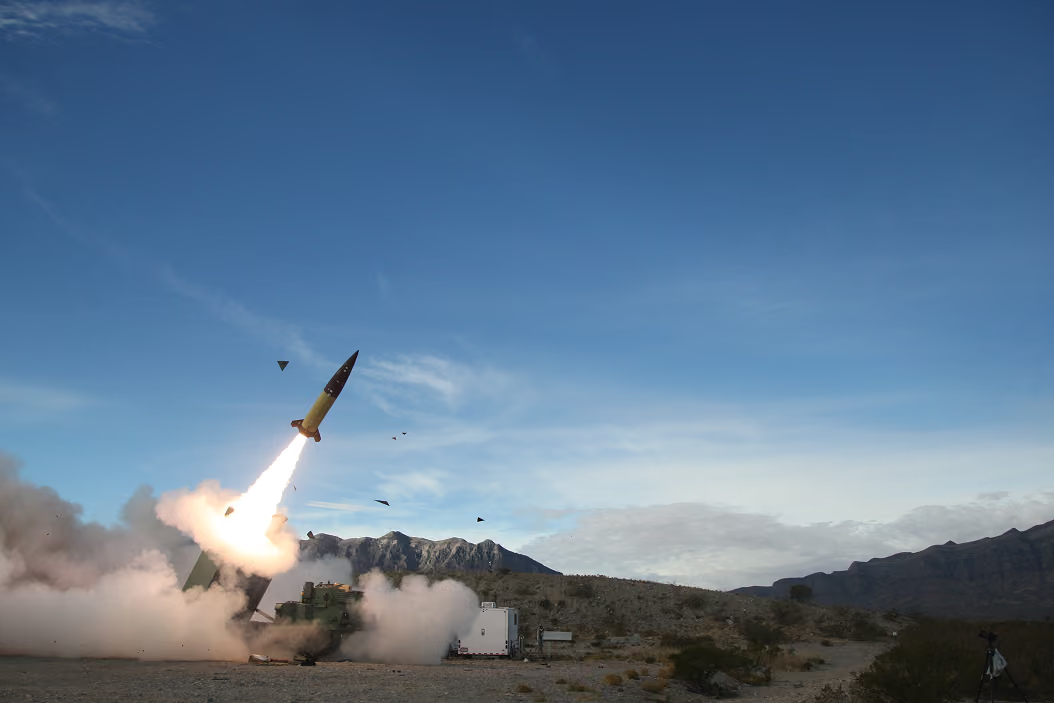

A CSIS report estimates the U.S. has expended roughly 65 percent of its Patriot interceptors and at least 38 percent of its THAAD ballistic missile interceptors since February, while virtually all long-range precision missiles have been depleted, raising concerns about stockpile levels.
Dig Deeper
The White House pushed back on the report, saying the military has "far more munitions than anyone in the world, and far more than we need." Read more from Newsweek. Meanwhile, the Pentagon signed framework agreements with Northrop Grumman and Lockheed Martin to significantly expand production of missile interceptor components, with PAC-3 and THAAD system output set to triple and quadruple respectively. Read more from The Hill.
Top Headlines
The figure that would make it among the most expensive warships ever procured. The assessment reflects the full lifecycle cost of the program, including a steep per-unit estimate for the first ship consistent with the historical pattern of lead-vessel costs.
Defense Secretary Pete Hegseth's nominee for Army chief of staff, Gen. Christopher LaNeve, faces bipartisan resistance in the Senate Armed Services Committee, where he requires unanimous Republican support to advance.
The Pentagon's counterdrone task force awarded Kaizen Laboratories $15 million to build a "two-way" marketplace designed, in part, to make selling tech to foreign militaries easier.
The order, signed at a ceremony that took place alongside Hegseth, his wife Jennifer, Chairman of the Joint Chiefs Gen. Dan Caine, and several military spouses, creates a commission aimed at addressing challenges faced by military families.
Defense industry executives expressed confidence in Pentagon spending levels during mid-year earnings calls, citing bipartisan congressional support for increased munitions procurement despite uncertainty surrounding the FY27 budget. RTX CEO Chris Calio and peers pointed to strong demand signals across key programs as indicators of sustained or growing defense investment.

Air Force portfolio acquisition executives say a reshuffling of acquisition authority is changing how they oversee modernization, sustainment, and contracting as the service works to complete a broader restructuring of its acquisition enterprise. The shift moves decision-making authority closer to the portfolio level, altering how programs are managed across their life cycles and how contracts are structured and awarded.
The Senate Homeland Security and Governmental Affairs Committee unanimously advanced Rep. Nancy Mace's Skills-Based Federal Contracting Act, which would eliminate education degree requirements for federal contracting positions in favor of skills-based hiring criteria.
Lt. Gen. Doug Schiess has been confirmed as the third Chief of Space Operations, inheriting a growing Space Force that faces significant acquisition and workforce challenges alongside plans for further expansion.

Chinese officials are preparing a package of potential retaliatory measures — including targeted sanctions and restricted-entity listings — against U.S. artificial intelligence companies, with Anthropic among the firms under consideration, as Beijing weighs its options ahead of a Trump-Xi summit. The move reflects deepening friction over AI competition and technology access, with China signaling it is prepared to escalate economic pressure on American AI developers if bilateral tensions are not resolved at the leadership level.
Dig Deeper
The U.S. Treasury secretary warned that sanctions remain on the table after the White House accused Beijing-based Moonshot AI of improperly distilling Anthropic's Fable model. Read more from TechChrunch. Preparations for the upcoming U.S.-China summit are already strained by new tariffs, additional Chinese firm listings, and mounting trade disputes between the two countries. Read more from Semafor.
Why you should read The MC Post every Saturday morning.
We're bringing back the familiar comfort of unfolding the weekend newspaper and catching up on the headlines, without the tacky popups, scammy ads, or bait-and-switch paywalls that you've come to know and hate. In a world racing toward AI-generated content, The MC Post is curated by people for people. Brought to you by Mission Cultivate—the free networking platform for defense and national security pros. Each week here you'll find the latest in defense and industry to keep you informed ... and more importantly, save you some time. (Subscribe)
FeatureD Opinions
Future drone warfare dominance will hinge on the resilience and capability of the networks connecting unmanned systems rather than sheer numbers fielded, arguing that AI-enabled coordination, secure communications, and interoperability between platforms will be decisive factors in peer-level conflicts.
Paul Hayden Miller argues the U.S. should use the conflict with Iran as a catalyst to rebuild its defense industrial base and domestic manufacturing capacity, framing the moment as a strategic opportunity to address long-standing production shortfalls and supply chain vulnerabilities.
Federal agency leaders are urged to design AI governance frameworks around continuous adaptation, given the rapidly evolving technological landscape that makes static policy structures inadequate for managing emerging AI capabilities and risks across government.
In the weeds
The Commerce Department has disbursed $13.1 billion of $31.5 billion in CHIPS Act direct funding across 49 projects involving 24 companies, with all required milestones met on time as of April 2026, though some have fallen behind anticipated schedules. Commerce subsequently canceled $7.8 billion of the $11 billion appropriated for advanced R&D activities — including the National Semiconductor Technology Center — and paused or canceled National Advanced Packaging Manufacturing Program awards, moves the agency attributed to a realignment with current administration priorities.
Happening on MC
If you're not on Mission Cultivate, here's just some of what you're missing.
Event Conversations
Continue Reading
The Pentagon's Chief Digital and Artificial Intelligence Office has appointed a new program director for Maven Smart System as part of a renewed effort to establish MSS as a central command-and-control platform, though some sources have questioned the program's impact to date.
The Department of Homeland Security has begun awarding contracts totaling $1.5 billion for counter-drone defense capabilities to firms including Anduril, Booz Allen Hamilton, and GDIT, as the agency works to address shortfalls in counter-UAS skills and readiness.

U.S. Southern Command has established Joint Task Force Western Hemisphere, led by Marine Corps Maj. Gen. Kevin Jarrard, to integrate military capabilities with 18 partner nations of the Americas Counter Cartel Coalition in coordinated counter-narcotics and security operations across the region.
Lockheed Martin is pursuing agreements to secure U.S.-sourced mineral supplies, following the Trump administration's push to build domestic critical mineral supply chains for defense manufacturing and reduce reliance on foreign sources.
The Navy has established a new Dedicated Requirements and Program Management (DRPM) office for Robotic and Autonomous Systems (RAS), with Chris Miller named as acting DRPM RAS and PAE RAS, signaling an organizational push to centralize oversight of unmanned and autonomous platforms.

LinkedIn: B*mb
Mission Cultivate: Bomb
Mission Cultivate is the free, discreet networking platform for Defense and NatSec. Stop censoring yourself and speak freely in the only space made just for you.
See Mission CultivateHeads up: MC is only for verified users in Defense/War & NatSec. Users include gov, industry, academia, vc, and more. Only available to US, NATO, or select major US allies.