Just like old times.



Sec. Hegseth testified before the Senate that the Iran war has cost approximately $37.5 billion, defending a supplemental funding request amid a contentious hearing with lawmakers questioning the administration's military expenditures and war justification.
Dig Deeper
Senators continue to cast doubt on the prospects of a new reconciliation bill, raising concerns that defense-related provisions included in the package may fail to advance given the slim likelihood of a third reconciliation effort passing Congress. Read more from Breaking Defense.
Top Headlines
The House passed its fiscal year 2027 National Defense Authorization Act, with House Armed Services Committee Chairman Mike Rogers urging members to view the bill as one step in a longer legislative process while the measure remains stalled in the Senate.
The bipartisan Federal Improvement in Technology Procurement Act passed the House, aiming to modernize federal technology purchasing by raising acquisition thresholds and permitting pre-payments for cloud services — provisions that stalled in the previous Congress.
Amid renewed hostilities, President Trump as of Friday was weighing whether to launch a "massive attack" on the Islamic Republic that would be "bigger than ever before."
The Pentagon's special operations office is hosting a one-day accelerator event in the national capital region where representatives from more than a dozen companies will pitch innovative solutions across nine technology areas relevant to the special operations community.
A new executive order tightens restrictions on U.S. defense contractors purchasing critical minerals and other materials from prohibited foreign suppliers, making it harder to obtain waivers that previously allowed such transactions.
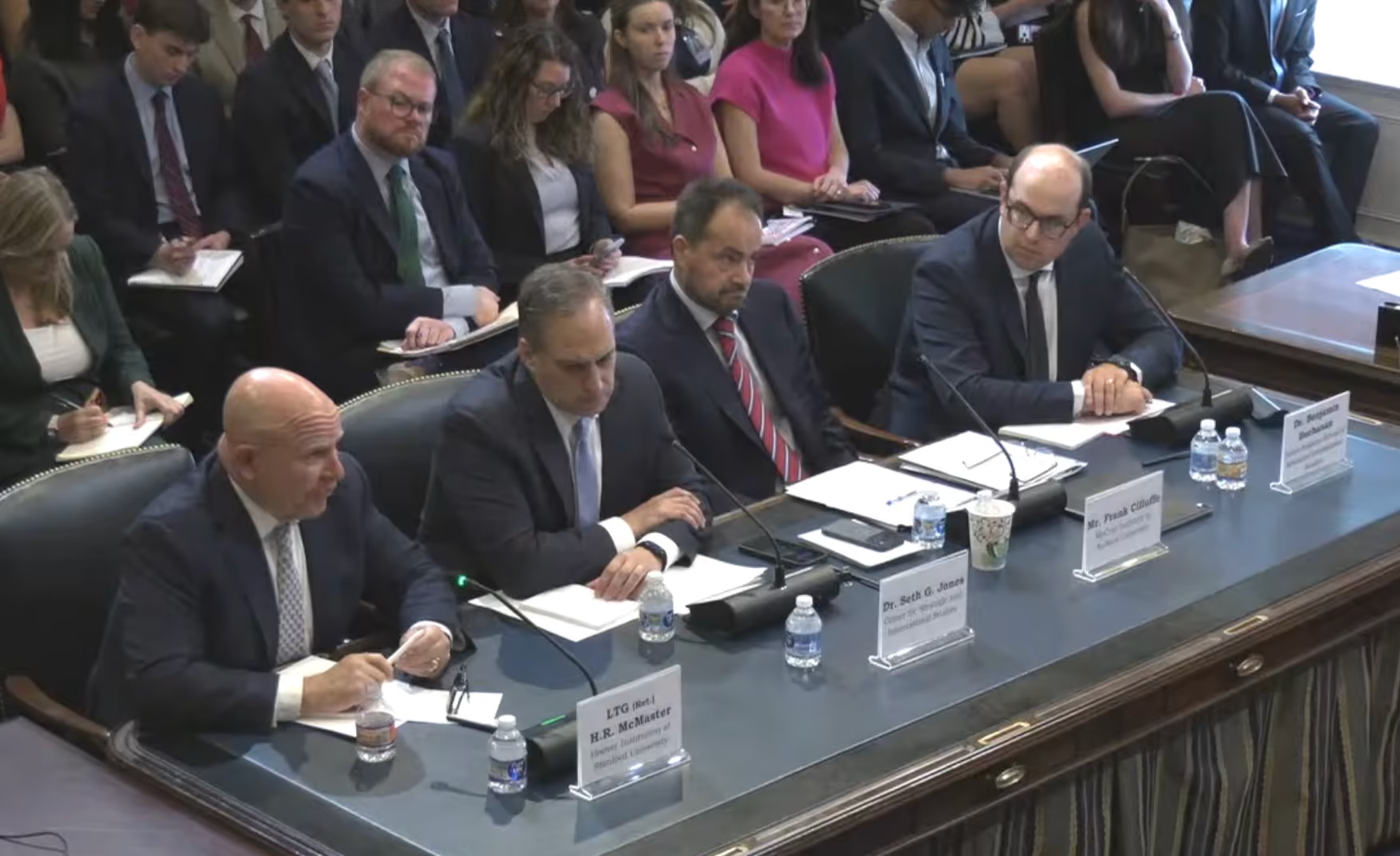
Former U.S. intelligence officials warned the House Intelligence Committee that American counterintelligence efforts have fallen dangerously behind China's systematic campaign to steal artificial intelligence technology from U.S. research laboratories and private companies. Witnesses urged lawmakers to strengthen legal authorities, increase funding, and improve coordination between the intelligence community and private-sector AI developers, arguing that current frameworks were designed for an era before AI became a central axis of great-power competition. Congress is now under pressure to weigh legislative options — including expanded counterintelligence mandates and new requirements for AI firms to report foreign contact — as the U.S. works to protect what officials described as a narrow but eroding technological advantage over Beijing.
A bipartisan group of senators is pressing the Office of Federal Procurement Policy to implement a two-years-overdue law addressing conflicts of interest in government contracting, requesting a concrete plan to update the Federal Acquisition Regulation accordingly.
Ukrainian President Volodymyr Zelenskyy replaced top commander Oleksandr Syrskyi with Mykhailo Drapatyi, pledging that medium and long-range strike operations against Russia will continue under the new leadership. The command change follows a major political dispute and street protests.

The Pentagon has expanded its Drone Dominance Program by issuing a new request for solutions specifically focused on "reusable bomber/dropper platforms," adding a dedicated bomber category to an initiative already designed to accelerate the military's unmanned capabilities. The move signals a push to develop drones capable of delivering munitions and returning for repeated use, broadening the program's scope beyond its original framework.
Dig Deeper
The Pentagon's Drone Dominance competition is driving a broader shift in defense acquisition, with startups playing an increasingly prominent role in supplying military drone technology and reshaping how the Department of War cultivates and contracts with non-traditional defense firms. Read more from Defense News. And Air & Space Forces Magazine gets a look at the Air Force's new counter-drone units.
Why you should read The MC Post every Saturday morning.
We're bringing back the familiar comfort of unfolding the weekend newspaper and catching up on the headlines, without the tacky popups, scammy ads, or bait-and-switch paywalls that you've come to know and hate. In a world racing toward AI-generated content, The MC Post is curated by people for people. Brought to you by Mission Cultivate—the free networking platform for defense and national security pros. Each week here you'll find the latest in defense and industry to keep you informed ... and more importantly, save you some time. (Subscribe)
Feature Opinions
LMI's Robert Yon argues the U.S. military already possesses the technology needed to build a comprehensive, near-real-time common operating picture for logistics, and that the missing piece is integration — linking existing systems from depot to point of detonation to improve supply chain visibility and readiness.
Carlo Viray of Rise8 argues federal agencies can escape the "messy middle" of IT modernization by adopting continuous delivery and incremental change strategies, particularly as AI raises the stakes for upgrading legacy systems and infrastructure that cannot support modern workloads.
Amid growing bipartisan support for establishing a dedicated Cyber Force — including a failed Senate Armed Services Committee amendment by Sen. Kirsten Gillibrand and Rep. Pat Fallon's prediction that such a force is "inevitable" — the argument here is that the Defense Department must first fix its cyber governance structures before creating a new military branch.
In the weeds
The U.S. and Saudi Arabia have reached a reported nuclear cooperation agreement under which the U.S. would transfer nuclear technology, materials, and equipment to the kingdom, raising questions among nonproliferation experts about safeguards and regional security implications.
Happening on MC
If you're not on Mission Cultivate, here's just some of what you're missing.
Opportunities
Event Conversations
Continue Reading
President Trump signed an executive order titled "Securing America's Defense Supply Chains and Ensuring Domestic Acquisition of Critical Materials," authorizing the use of artificial intelligence to map and secure defense supply chains and prioritize domestic acquisition of critical materials.
U.S. lawmakers participated in a CSIS-hosted tabletop exercise simulating AI-enabled Chinese cyberattacks on U.S. infrastructure in a China-Taiwan conflict scenario, testing congressional decision-making and responses to escalating hybrid warfare threats.
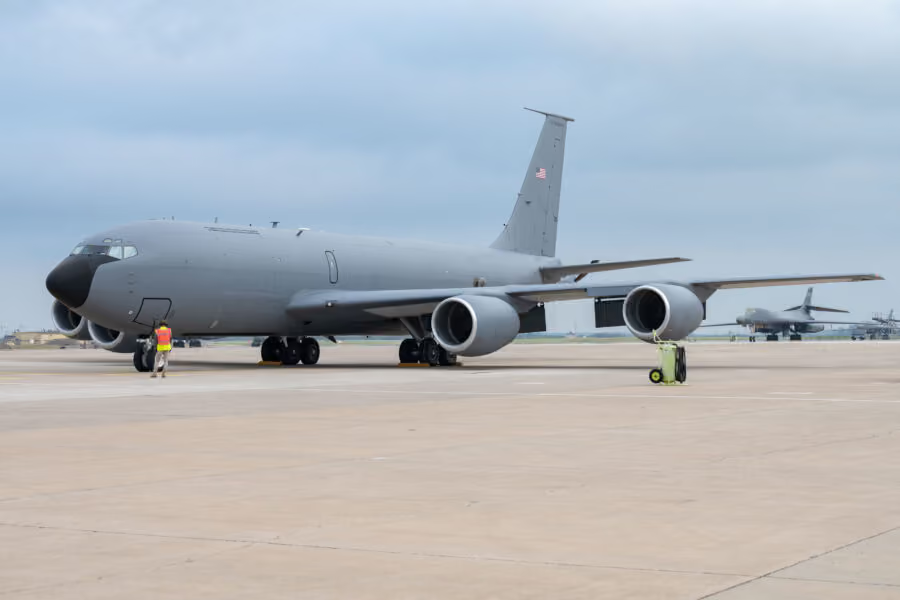
In an operational first, U.S. Transportation Command used AI agents to assist planners after Spain denied Air Force tankers access to its bases during strikes on Iran, marking the first operational deployment of AI agents by TRANSCOM to support a real-world military operation, Epic Fury.
President Trump stated the bridge 747 currently serving as Air Force One will be pulled from service to receive comprehensive upgrades, including defensive countermeasures, after questions arose about the aircraft's current systems.
The U.S. Department of Energy's Genesis Mission has expanded to include 20 federal agencies, among them NASA and the Department of Defense, reflecting a whole-of-government coordination effort around the initiative's broader national objectives.

LinkedIn: B*mb
Mission Cultivate: Bomb
Mission Cultivate is the free, discreet networking platform for Defense and NatSec. Stop censoring yourself and speak freely in the only space made just for you.
See Mission CultivateHeads up: MC is only for verified users in Defense/War & NatSec. Users include gov, industry, academia, vc, and more. Only available to US, NATO, or select major US allies.