Just like old times.

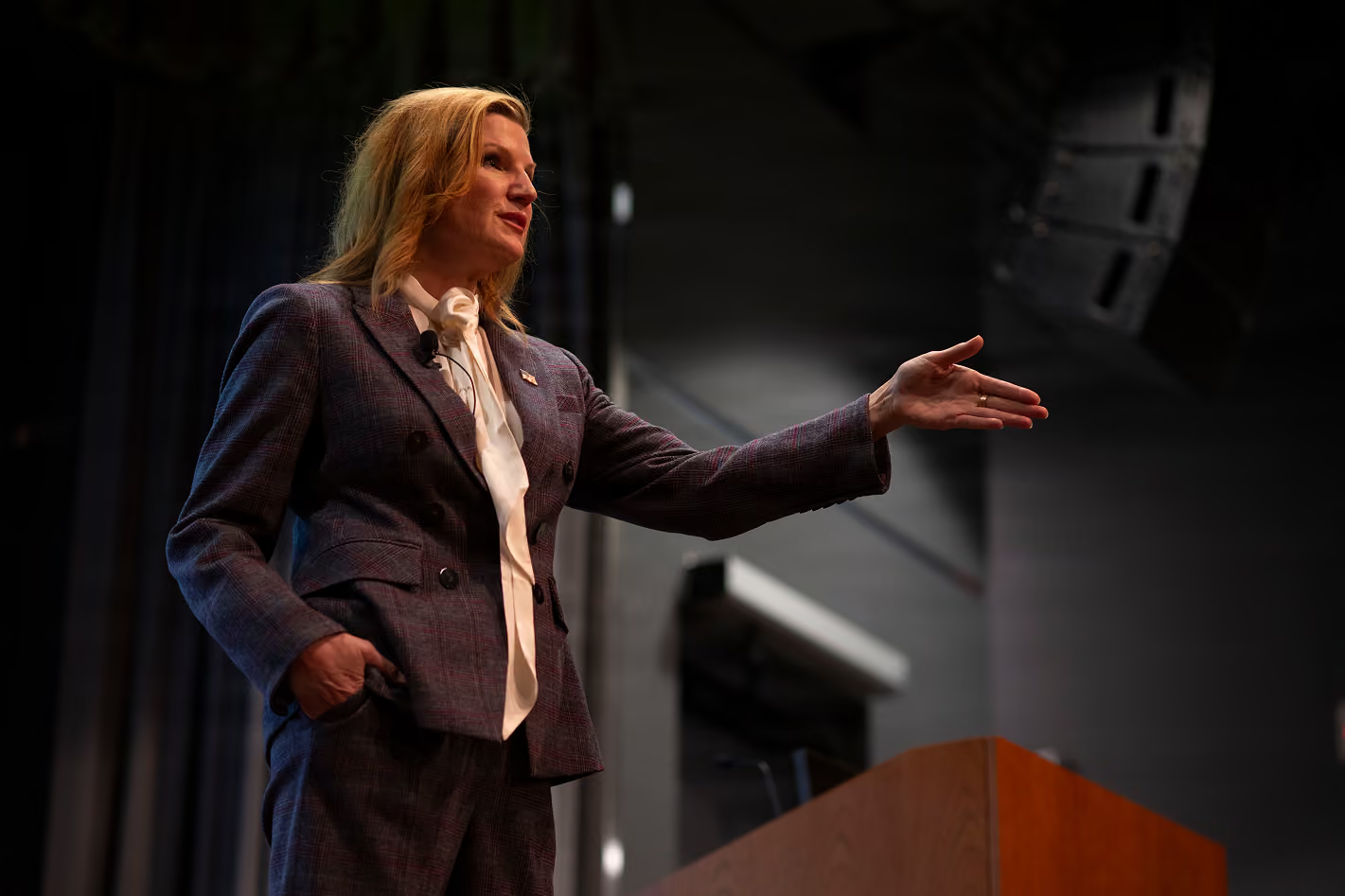

According to a release from the Pentagon, the department is responding to complaints that CMMC was increasing compliance costs and adding bureaucratic burdens. For now, the department will keep cybersecurity self-assessments, but will not require third-party certifications as planned.
Dig Deeper
Industry sources say cost and compliance burden concerns that prompted the Pentagon's CMMC suspension have been well-documented for years, even as the formal pause caught contractors off guard. Read more from Washington Technology. Meanwhile, the White House is establishing a new AI cybersecurity clearinghouse to help coordinate cybersecurity defenses across critical infrastructure. Read more from CNN.
Top Headlines
After nearly a week of renewed fighting, U.S. forces struck bridges and port infrastructure in southern Iran and boarded a vessel defying a blockade as Washington intensified efforts to weaken Tehran's control of the Strait of Hormuz.
President Trump's push for an additional $350 billion in defense spending as part of a $1.5 trillion defense budget is facing obstacles as Republicans' scaled-back reconciliation package threatens to significantly reduce the funding increase the administration sought.
The U.S. military plans to complete its withdrawal from Iraq by the end of September, confirmed by both Iraqi Prime Minister and Pentagon officials, marking a significant milestone in the winding down of the longstanding U.S. military presence in the country.
Jay Clayton, Trump's pick to lead the intelligence community, faced Democratic criticism during his confirmation hearing after repeatedly declining to affirm that Joe Biden won the 2020 election and defending subpoenas his Manhattan prosecutor's office issued to four New York Times journalists.
Sen. Lindsey Graham, a 33-year U.S. Air Force veteran and one of the most influential military voices in Congress, died July 12 following a sudden cardiac event at age 71. Graham retired in 2015 as a colonel in the judge advocate general corps.
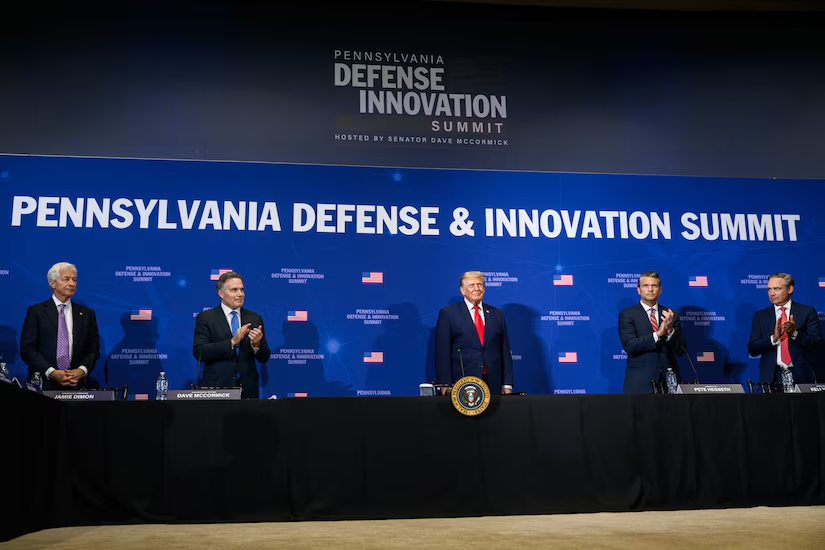
President Donald J. Trump announced that the War Department will be investing roughly $10 billion in materiel production while in support of more than 4,000 defense industry jobs. Trump made the announcement this week while delivering keynote remarks at the Pennsylvania Defense and Innovation Summit, an event that brought together leadership from the defense, finance and technology industries for two days at the U.S. Army War College in Carlisle, Pennsylvania.
Defense Innovation Unit director Owen West outlined his vision to reshape DIU's operational structure, with a focus on reducing the military's 'cost per kill' by accelerating the transition of commercial technology to warfighters, in an exclusive interview with DefenseScoop.
The U.S. Chamber of Commerce and 40 other business groups sent a letter to Senate leaders urging removal of an NDAA provision, championed by Sen. Elizabeth Warren, that would require Pentagon contractors to obtain Defense Department approval before executing stock buybacks or paying dividends.
Suspicious activity on the Department of Homeland Security's Homeland Security Information Network — currently supporting World Cup security operations across the U.S. — was detected in mid-to-late May but was twice dismissed as a false positive before the network intrusion was confirmed as a genuine breach.
The U.S. Air Force is shifting procurement strategy toward lower-cost cruise missiles purchasable in the thousands, aiming to dramatically reduce per-shot costs and increase inventory depth compared to legacy munitions programs.
Researchers have found that AI can now be used across every phase of a cyberattack, including identifying security vulnerabilities, generating attack commands, and executing portions of intrusions, raising significant concerns for national security and critical infrastructure defense.

In a move that is raising eyebrows at home, Ukrainian President Volodymyr Zelenskyy dismissed Defense Minister Mykhailo Fedorov after just six months in office, marking a significant leadership change within Ukraine's defense establishment amid the ongoing war with Russia.
Dig Deeper
A CSIS analysis examines how expanding long-range strike campaigns by both Ukraine and Russia are reshaping the conflict beyond front-line movements, and outlines steps international partners can take to strengthen Ukraine's strategic position.
Why you should read The MC Post every Saturday morning.
We're bringing back the familiar comfort of unfolding the weekend newspaper and catching up on the headlines, without the tacky popups, scammy ads, or bait-and-switch paywalls that you've come to know and hate. In a world racing toward AI-generated content, The MC Post is curated by people for people. Brought to you by Mission Cultivate—the free networking platform for defense and national security pros. Each week here you'll find the latest in defense and industry to keep you informed ... and more importantly, save you some time. (Subscribe)
Feature Opinions
Mitchell Institute dean David A. Deptula responds to a Breaking Defense op-ed on the "air littoral" concept as applied to the Iran conflict, arguing that altitude alone does not constitute a viable operational strategy in that theater or others.
Rebecca Hersman argues the June 12 forced takedown of Anthropic's Mythos 5 model over cybersecurity hazards calls for an AI Threat Fusion Center, citing a lack of standard processes, legal ambiguity, and information-sharing failures that left agencies conducting an ad-hoc response.
Robin Dickey examines proposed reforms aimed at improving information sharing and institutional relationships between Congress and the Pentagon, arguing the changes could make oversight more secure, flexible, and responsive to national security needs.
In the weeds
A new study finds that the U.S. defense industrial base is growing more capable of sustaining wartime production, driven by lessons from recent high-intensity conflicts that have rapidly consumed munitions and weapons stockpiles.
Happening on MC
If you're not on Mission Cultivate, here's just some of what you're missing.
Opportunities
Event Conversations
Continue Reading
The U.S. Air Force is being displaced from Ben Gurion Airport in Israel, forcing additional tanker aircraft to relocate after already drawing down a significant portion of its peak tanker presence there, raising questions about potential impacts on regional combat refueling capabilities.
The Department of War is facing pressure to restructure its acquisition models as software-centric drones evolve rapidly on the battlefield, prompting the defense industry to shift procurement approaches to accelerate drone deployment.
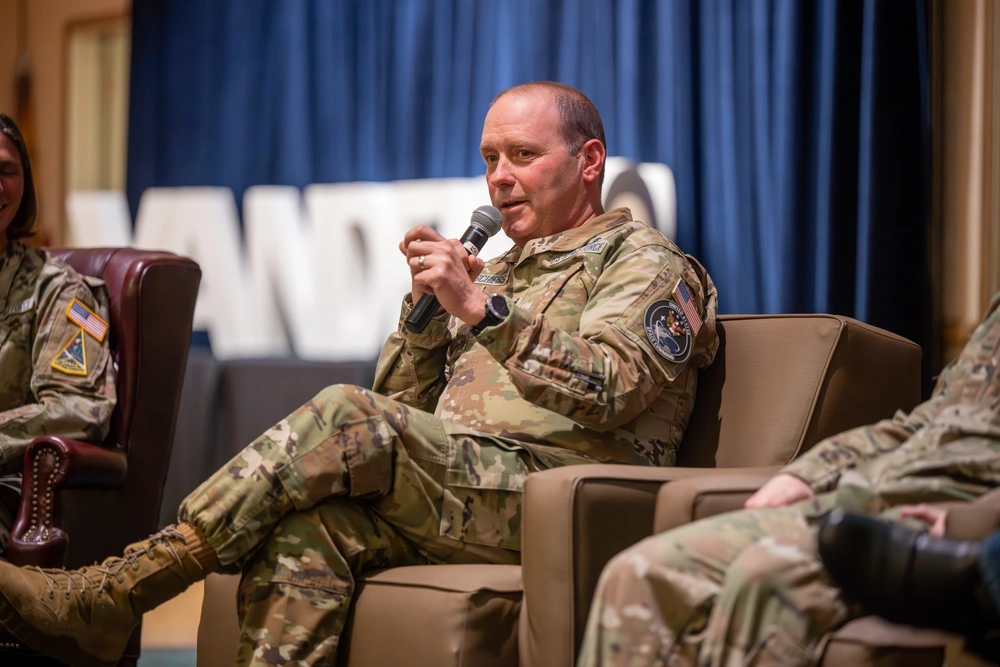
Lt. Gen. Douglas Schiess told senators recent conflicts, including operations involving Iran, underscore how space has become a contested warfighting domain where U.S. assets are among the first targets. His confirmation hearing reflected mounting concern over China's and Russia's counterspace capabilities and the service's shift from building a new military branch to preparing for conflict in orbit.
U.S. Army heavy units face significant counter-drone capability gaps that commanders warn could impair maneuver operations, with one commander stating that failure to rapidly address enemy UAS threats will undermine mission success.
The Pentagon closed applications early for its cyber apprenticeship program after receiving more than 15,000 submissions, with a Defense Department official indicating the agency plans to roll out additional apprenticeship positions over the coming weeks.

FREE, GovCloud-Secured Networking Platform for Defense and Industry
Mission Cultivate is the free, discreet networking platform for Defense and Industry. Find the others in national security and collaborate on the solutions warfighters need in one space.
See Mission CultivateHeads up: MC is only for verified users in Defense/War & NatSec. Users include gov, industry, academia, vc, and more. Only available to US, NATO, or select major US allies.