Just like old times.

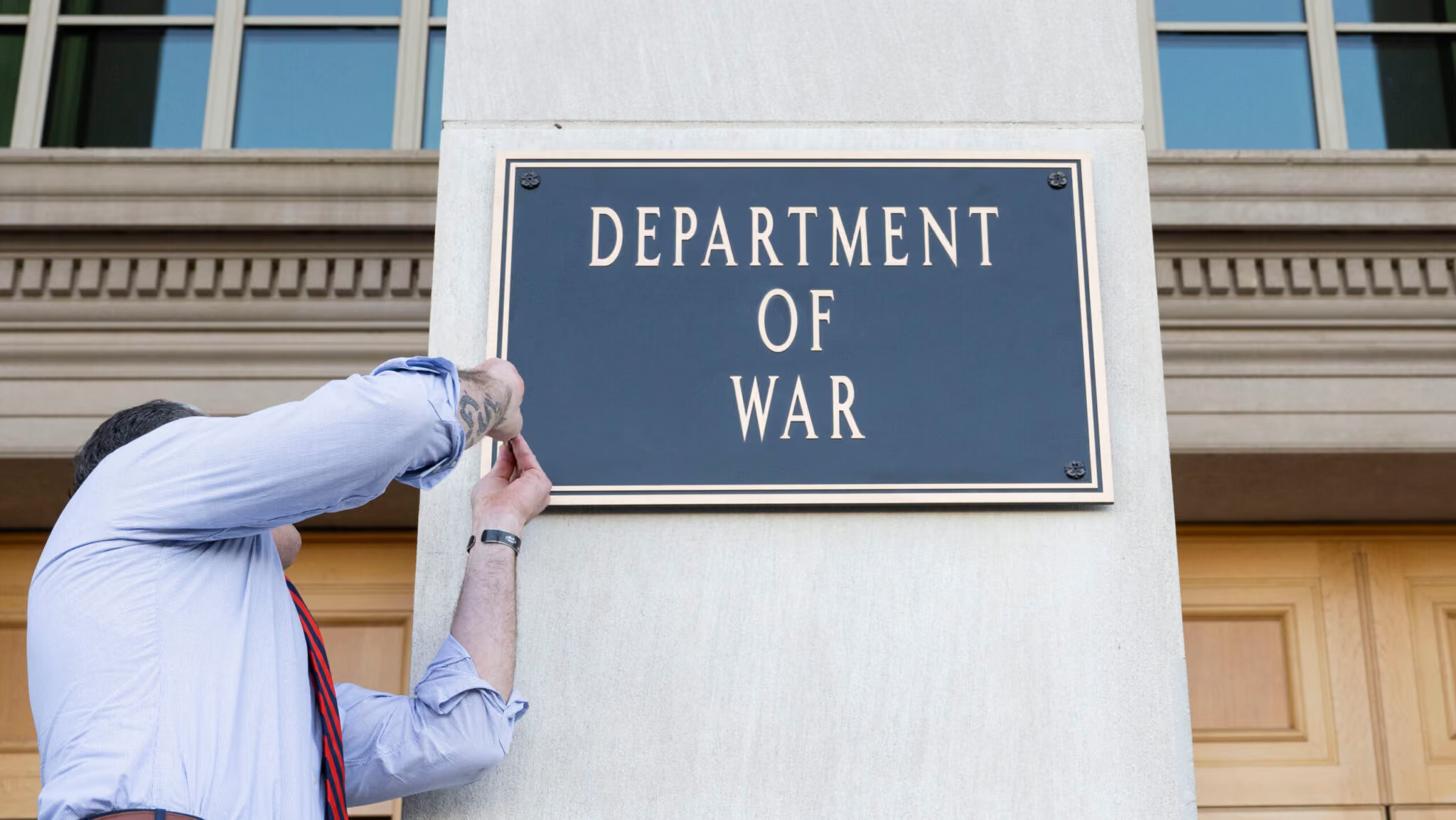

Although the $1 trillion spending bill is equivalent to the level requested by the Pentagon earlier this year, a committee report made public earlier this week sheds light on major shifts in money for programs like the Air Force's HH-60W combat rescue helicopter, while also highlighting concerns on munitions and the F-35 Joint Strike Fighter.
Top Headlines
The supplemental funding request, posted on the White House website and transmitted to Congress, includes $67.15 billion for the military, in addition to some $1 trillion appropriated last year and another $1.5 trillion President Trump wants for next year.
Republican senators switched their votes on an Iran war powers resolution late Wednesday, hours after a fractious meeting that included a shouting match with President Donald Trump over their opposition to the conflict.
The U.S. Army confirmed in a statement that Donahue will "relinquish command" on July 2. Maj. Gen. Christopher Norrie, his deputy, will "perform the duties of the commanding general."
Trump has summoned the top military contractors along with senior Pentagon officials to the White House to discuss increasing munitions production, a meeting that is expected to be contentious, The Wall Street Journal reported.
The Pentagon has already issued guidance to its program offices on how to spend the money before the deadline hits at the end of the fiscal year, a senior department official told Breaking Defense this week.

With vendors facing lengthy wait times to test new technology, the Army plans to increase industry access to its domestic ranges over the next several weeks, according to senior service officials, who said that at least two of those sites will mimic Ukrainian frontlines. The service is also planning to establish a range abroad where the Army and industry "can start to do much more aggressive testing," Army Secretary Dan Driscoll said Tuesday, though he declined to say which international U.S. ally the service will partner with to build it.
Dig Deeper
The Department of War has accepted the first batch of unmanned aerial systems under the Drone Dominance Program and shipped nearly 2,000 additional units to military services as the program advances into Gauntlet II. Read more from Executive Gov.
The Federal Regulatory Council is giving the federal community one more chance to speak up before the first set of major revisions to acquisition regulations becomes final. Federal acquisition experts will have 30 days to comment on proposed rules to help fine tune the changes initiated more than a year ago under the FAR overhaul.
Last week, President Trump held a press conference at Joint Base Andrews in Maryland to introduce the new Air Force VC-25B Bridge jet that officially arrived at the Presidential Airlift Group.
The Small Business Administration said today that agencies awarded 28% of all prime contracts to small firms last year. While agencies reached the overall goal, the total dollars going to small businesses dropped to $179 billion last year from $183.5 billion in 2024.

The official, who spoke on the condition of anonymity to discuss the matter, said Anthropic had teamed up with U.S. intelligence agencies to conduct tests using the company's Mythos model. It had identified certain vulnerabilities within hours, but that does not mean the model was able to exploit them within that time, the official said.
Dig Deeper
The Pentagon opted to purchase Casepoint's AI-enabled software products for classified legal operations and secure data workflows via a new blanket purchase agreement worth up to $98.8 million, officials from the company announced Wednesday. Read more from Defense Scoop. Also, the Department of War launched "Agent Network," the second Pace-Setting Project (PSP 2) and key element of the Department's new Artificial Intelligence (AI) Acceleration Strategy.
Why you should read The MC Post every Saturday morning.
We're bringing back the familiar comfort of unfolding the weekend newspaper and catching up on the headlines, without the tacky popups, scammy ads, or bait-and-switch paywalls that you've come to know and hate. In a world racing toward AI-generated content, The MC Post is curated by people for people. Brought to you by Mission Cultivate—the free networking platform for defense and national security pros. Each week here you'll find the latest in defense and industry to keep you informed ... and more importantly, save you some time. (Subscribe)
Feature Opinions
Mike Lyons argues that a reported $20,000 Iranian loitering munition threatening a $30 million Apache exposes a cost-asymmetry crisis the Pentagon has not moved fast enough to solve. The U.S. needs urgent procurement reform to field low-cost counter-drone defenses at scale, because relying on expensive interceptors and slow acquisition timelines leaves manned platforms vulnerable outside protected defensive "bubbles."
As the government overhauls its procurement rulebook, contractors are still grappling with a persistent problem that shapes how they price, plan, and perform work: what information must be protected and who is responsible for identifying it.
The Senate's version of the 2027 National Defense Authorization Act includes a provision to create a new slush fund within the U.S. Treasury for the purpose of buying stakes in more private businesses. The Pentagon would be able to tap the proposed Defense Equity Investment Account to make investments of up to $500 million in private companies involved in the production of "critical minerals, materials, and chemicals" or batteries.
In the weeds
"Space presents a uniquely complex warfighting environment. The global and technical nature of the domain complicates the understanding of and response to hostile acts," Mitchell Institute researchers wrote in a new report. "As a result, attribution, escalation management, and credible response selection are daunting. Further, actions taken in space rarely produce isolated or localized effects; instead, they cascade across geographic combatant commands, civilian infrastructure, and global equities."
Happening on MC
If you're not on Mission Cultivate, here's just some of what you're missing.
Opportunities
Event Conversations
Continue Reading
An internal Pentagon review published Wednesday warns that decades of underfunding has led to alarming deterioration in facilities doing military research. The armed services raid lab funding for more urgent needs like barrack repairs, the study says, leaving researchers in aging, outdated labs "that pose documented safety risks."
President Trump tapped Matt O'Malley in April to serve as deputy undersecretary of defense for acquisition who appears to be an intelligence officer in the Navy Reserve without high-level experience managing weapons purchases or the upkeep of military equipment.

A presidential memo, signed June 11 and directed to Defense Secretary Pete Hegseth, cites "systemic constraints in the munitions industrial base, including limited production capacity, fragile supply chains, long-lead dependencies, and related production bottlenecks" that may impair the country's ability to field the weapons it needs.
Iranian-aligned cyber actors have adopted artificial intelligence-enhanced techniques to target space systems during the Iran war, with the technology improving the quality of their attacks and making it harder to track their activity, experts said June 23.
The app, called the Operational Data Integration Nexus (ODIN), will be housed in the Defense Department's Maven Smart System. The MSS platform, powered by AI, was built by Palantir and has been widely adopted across the military, including by combatant commands.

FREE, GovCloud-Secured Networking Platform for Defense and Industry
Mission Cultivate is the free, discreet networking platform for Defense and Industry. Find the others in national security and collaborate on the solutions warfighters need in one space.
See Mission CultivateHeads up: MC is only for verified users in Defense/War & NatSec. Users include gov, industry, academia, vc, and more. Only available to US, NATO, or select major US allies.